
Ring External Fixator: Circular Frame Design, Applications and Buying Guide
A Ring External Fixator is a circular orthopedic fixation system that connects bone to an external frame using wires, half pins or both. Depending on the selected system and clinical plan, circular fixation may support fracture stabilization, deformity correction or bone reconstruction. Its configuration is tailored to the treatment requirements.
For clinicians, the important considerations include the intended application, frame arrangement and associated instruments. For hospital procurement teams, accurate purchasing begins with a defined list of rings, connecting components, bone attachments and accessories.
This guide explains circular frame terminology, the applications described for ring fixation and the questions buyers should ask before requesting a quotation.
What Is a Ring External Fixator?
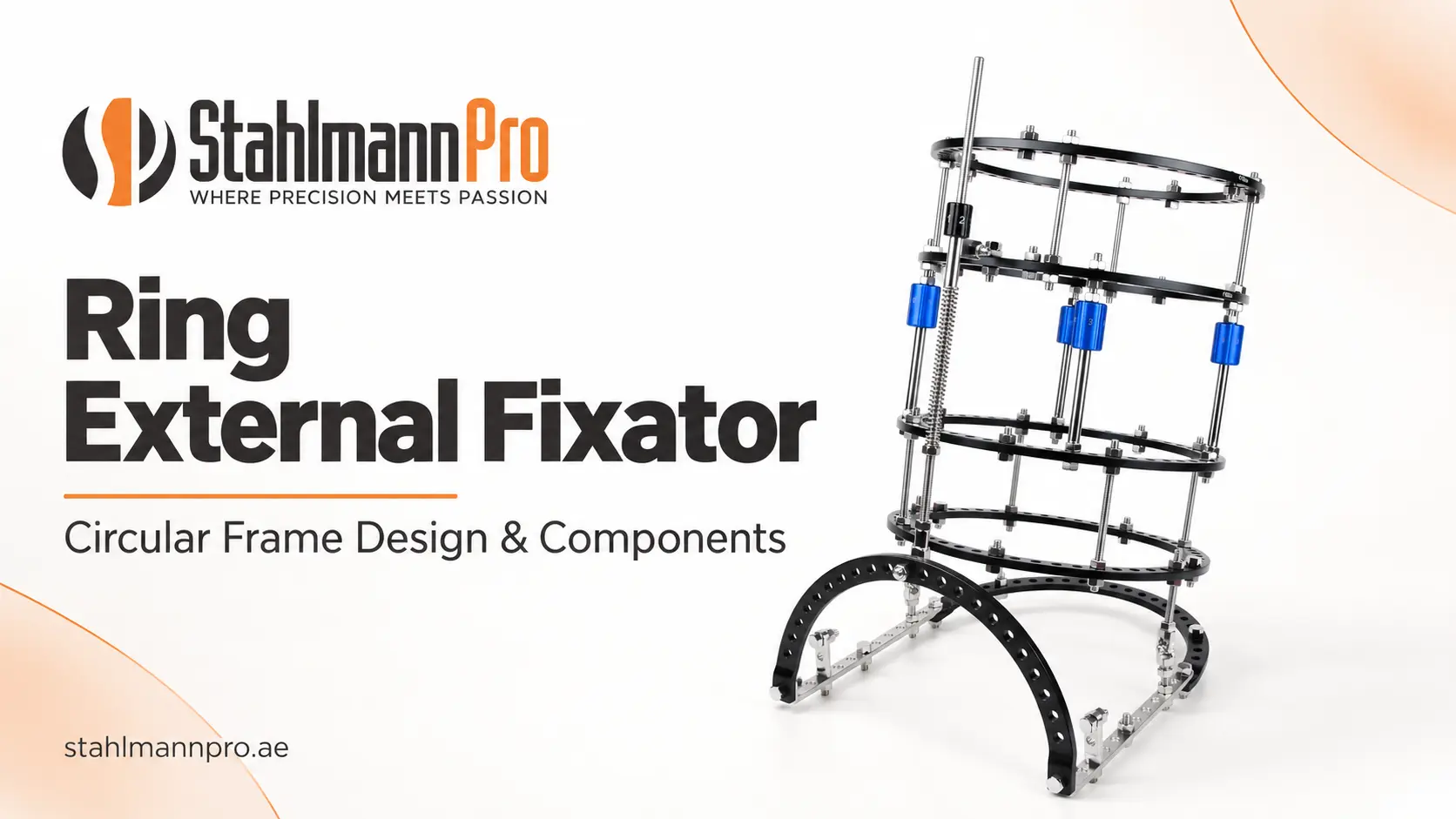
A ring external fixator uses circular or partial-ring structures positioned around a limb. Connecting elements link the frame sections, while compatible wires or half pins provide the attachment to bone.
The assembled frame is a construct. Its appearance varies according to the treatment plan and the selected components.
The word “ring” identifies the general architecture. It does not establish one standard ring size, material, adjustment mechanism or package.
For product evaluation, distinguish between:
- A complete circular frame.
- Individual rings or partial rings.
- Connecting rods or adjustment components.
- Wire and pin attachment hardware.
- Dedicated instruments.
- Replacement accessories.
This distinction helps prevent confusion when comparing a complete-system quotation with an offer covering only selected components.
How Does a Circular External Fixator Work?
A circular external fixator links the treated bone segments to an external supporting structure. The selected connections establish the relationship between the bone attachments and frame sections.
Some circular systems use rings connected by straight rods. Hexapod systems use a different arrangement involving six adjustable struts. These designs should not be treated as having identical adjustment mechanisms or component requirements.
A product enquiry should identify which design is required. Requesting a “ring fixator” without further details may leave important questions unanswered.
The clinical team determines the appropriate construct. Purchasing teams should translate that requirement into an itemized specification covering the components and instruments needed.
Which Parts Make Up a Ring External Fixator?
The exact inventory depends on the system. A component list should identify both the frame elements and the hardware used to connect them.
| Component group | Information to identify |
|---|---|
| Full rings or partial rings | Diameter, geometry, material and quantity |
| Connecting rods | Length, thread specification and compatible hardware |
| Adjustment components | Mechanism, range and system compatibility |
| Wires | Diameter, length and compatible fixation hardware |
| Half pins | Dimensions, thread design and matching clamps |
| Wire and pin fixation hardware | Compatible interfaces and quantities |
| Nuts, bolts and washers | Required dimensions and connection type |
| Instruments | Matching insertion, assembly and adjustment tools |
| Trays or cases | Whether included in the package |
Ring diameter alone does not establish complete compatibility. Hole patterns, thread interfaces and attachment mechanisms also need confirmation.
Retaining the approved inventory helps support future replacement purchases.
Which Applications Are Associated With Circular Fixation?
Circular fixation is used in specialist fracture and limb-reconstruction practice. General applications include selected fracture stabilization, bone correction and lengthening procedures.
The suitability of an individual device must be established through its intended use and the treating team’s assessment. A broad description of circular fixation should not be transferred automatically to every ring system.
Readers can explore the Ilizarov Type External Fixator System for related product enquiries. Request the configuration and documentation relevant to the proposed application.
For a broader overview of frame categories, read the External Fixation System guide.
Can a Ring Fixator Support Bone-Defect Reconstruction?
Circular fixation may form part of a specialist bone-reconstruction plan. Bone transport is one reconstructive approach associated with external fixation, but it requires a defined clinical strategy rather than a frame alone.
Bone transport involves moving a bone segment through a planned process to address a defect. It should be distinguished from simply lengthening a bone.
The International Center for Limb Lengthening describes external fixation within its reconstructive treatment resources, including bone transport and deformity correction. The required procedure and device configuration depend on the individual case.
For procurement, identify the components requested by the reconstruction team. Do not assume that a standard package contains every accessory needed for a bone-transport construct.
How Does a Ring Fixator Support Deformity Correction?
Circular fixation may support planned changes in bone position. Correction can be performed through different clinical approaches, depending on the condition, procedure and system.
An acute correction and a gradual correction represent different treatment strategies. They should not be described as interchangeable capabilities of every frame.
Gradual correction uses a prescribed adjustment plan and ongoing monitoring. The adjustment mechanism must match the system being used.
Patients should only adjust a frame when specifically instructed and trained. A product description is not an adjustment schedule.
Buyers should identify the required connecting and adjustment components before requesting a quotation.
Can Circular Fixation Be Considered After Delayed Treatment?
The timing of treatment is one factor in clinical planning. A delayed presentation does not establish that a ring fixator will achieve anatomical reduction in every case.
The appropriate approach depends on the condition of the bone, surrounding tissues and the objectives of treatment.
For product communication, it is more accurate to describe circular fixation as a system that may support selected complex reconstruction or correction plans. Claims that it guarantees anatomical reduction, including after delayed treatment, require case-specific evidence.
Hospitals should request the device intended by the treating team rather than choose a frame solely because it is promoted for difficult fractures.
Does a Ring Fixator Minimize Soft-Tissue Trauma or Bleeding?
Soft-tissue management and blood supply are important considerations in orthopedic treatment. However, the extent of tissue disruption and bleeding depends on the entire procedure.
External fixation uses bone attachments that pass through the skin. Additional surgery may be required for the condition being treated. A circular frame does not, by itself, establish minimal bleeding or freedom from tissue injury.
Similarly, preservation of blood circulation should be discussed as a treatment consideration rather than a guaranteed product result.
These distinctions help keep product information useful. Device construction can be described directly, while clinical advantages should be supported by evidence relevant to the procedure and patient group.
What Determines the Stability of a Ring Fixator?
The assembled construct must provide the support required by the clinical plan. Stability cannot be established from the presence of circular rings alone.
For technical evaluation, request information describing the tested configuration and the conditions under which it was assessed.
Useful questions include:
- Which components were included in the evaluated assembly?
- What ring and connection dimensions were used?
- What loading conditions were assessed?
- What limitations apply to the results?
- Does the proposed configuration match the documented assembly?
“Optimum biomechanical stability” is not a complete specification. A meaningful evaluation identifies the actual construct and supporting evidence.
Component selection and assembly should follow the system instructions.
Can Patients Begin Early Joint Movement?
Movement and rehabilitation require an individual plan. A ring frame does not automatically permit unrestricted joint movement or weight-bearing.
Patients should receive instructions explaining permitted activity, exercises and any restrictions. The frame configuration and treatment objective affect what is appropriate.
For example, a construct that spans a joint raises different rehabilitation questions from one that does not. The treating team should explain the plan for the individual assembly.
The Royal National Orthopaedic Hospital emphasizes the importance of prescribed exercises and patient participation during external fixation treatment. Patients should follow the guidance provided for their own frame.
How Do Ring and Monolateral External Fixators Differ?
A circular frame surrounds the limb with rings or partial rings. A monolateral system generally positions its supporting structure along one side.
| Feature | Ring external fixator | Monolateral external fixator |
|---|---|---|
| General architecture | Circular or partial-ring frame | Supporting structure mainly along one side |
| Connections | System-specific ring connectors | System-specific bars, bodies and clamps |
| Bone attachments | May use wires, half pins or both | Commonly uses half-pin connections |
| Configuration | Selected for the treatment plan | Selected for the treatment plan |
| Purchasing requirement | Detailed component inventory | Detailed component inventory |
The comparison explains frame architecture. It does not establish that one approach is better for every patient.
Is Every Ring Fixator an Ilizarov Fixator?
“Ring external fixator” is a broad description. Ilizarov-type systems are one form of circular fixation.
Buyers should identify the actual mechanism rather than assume that all circular devices use the same components or adjustment method.
For an Ilizarov ring fixator enquiry, specify the requested rings, connectors, attachments and instruments. If an existing construct needs replacement components, include its identification.
Matching appearance or nominal dimensions alone should not be treated as evidence of compatibility between different systems.
Which Specifications Should Buyers Request?
A purchasing specification should reflect the assembly requested by the clinical team.
| Specification | Information to confirm |
|---|---|
| System identification | Exact product and configuration |
| Ring options | Full rings, partial rings and available diameters |
| Frame material | Material and grade for each relevant component |
| Connecting elements | Lengths, interfaces and quantities |
| Bone attachments | Compatible wire and half-pin options |
| Adjustment mechanism | Available components and documented capabilities |
| Instruments | Required assembly and application tools |
| Package contents | Itemized supplied inventory |
| Supplied condition | Product labeling |
| Processing and reuse | Component-specific instructions |
| Traceability | Product and batch identification |
A photograph is useful for orientation, but it should accompany the written specification.
What Determines the Ring External Fixator Price?
The Ring External Fixator price depends on the configuration and supplied contents. A single ring, a connector set and a complete frame represent different purchasing scopes.
For a meaningful comparison, quotations should identify equivalent:
- Ring sizes and quantities.
- Connecting components.
- Bone attachment hardware.
- Adjustment accessories.
- Instruments and trays.
- Supporting documentation.
The device purchase price should be separated from the wider cost of surgery, hospital care and follow-up.
To request an external ring fixator quotation, provide the required inventory and destination. Ask for current availability and the terms applicable to the order.
What Should Buyers in Africa, Latin America and Russia Specify?
Hospitals and distributors should identify the destination country when requesting product information.
Include any language, labeling and documentation requirements needed for purchasing review. Do not assume that one documentation package applies across an entire region.
For distributor stock planning, separate complete systems from replacement components. Maintain clear references for repeat orders.
When preparing local budgets, identify the quotation currency and keep any currency conversion separate and dated.
Product availability should not be interpreted as confirmation of authorization in every destination market. Review the applicable documentation for the product and intended destination.
Frequently Asked Questions
What is a ring external fixator?
It is a circular frame connected to bone through compatible attachments. Its configuration is selected according to the treatment plan and system documentation.
What is a circular external fixator used for?
Circular fixation is associated with selected fracture stabilization and limb-reconstruction procedures. Individual applications require clinical assessment and confirmation against the device’s intended use.
Can a ring fixator support bone transport?
It may form part of a specialist bone-transport plan. Confirm the intended application and required configuration rather than assuming every standard frame includes the necessary components.
Does it guarantee anatomical fracture reduction?
No guaranteed result should be inferred from the product name. Reduction and alignment depend on the clinical situation, procedure and treatment plan.
Is gradual correction the same as lengthening?
No. Correction concerns the planned change in bone position or alignment. Lengthening concerns bone length. Some treatment plans may involve both.
How long can a ring fixator stay on?
Duration depends on the treatment objective and assessment of progress. The treating surgeon determines removal timing. There is no universal schedule.
Can patients walk with a circular frame?
Permitted weight-bearing must come from the treating team. The presence of a frame does not automatically permit unrestricted walking.
Is a ring fixator MRI safe?
Check the labeling for the exact assembly. Material names or the appearance of the rings do not establish MRI conditions.
Are instruments included with the frame?
Check the itemized quotation. Instruments, bone attachments and frame components may have separate purchasing requirements.
Can buyers order replacement rings and connectors?
Include the existing system identification, component dimensions and required quantities. Request confirmation of availability and compatibility.
How Can You Buy a Ring External Fixator?
To buy a Ring External Fixator, prepare an enquiry with the required configuration, ring dimensions, connecting components, bone attachment requirements and instrument needs.
Stahlmann Pro welcomes enquiries from hospitals, orthopedic distributors and procurement teams in Africa, Latin America and Russia.
Explore the External Fixation System range or contact Stahlmann Pro to request specifications, current availability and an itemized quotation.
Email: info@stahlmannpro.ae
Phone / WhatsApp: +971 50 975 0822
