
Small Fragment External Fixator: Carbon Fiber Rods, Components and Buying Guide
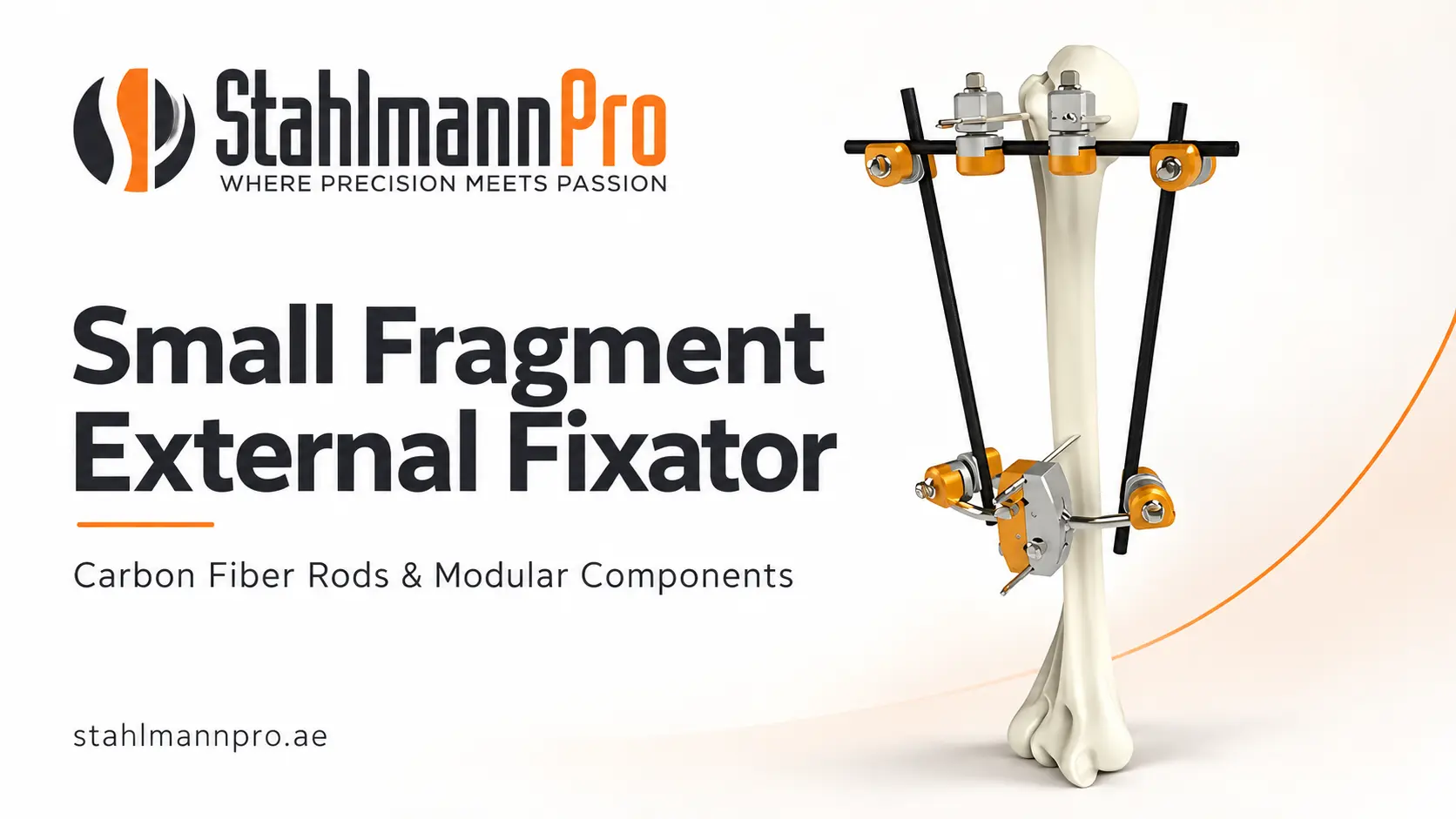
A Small Fragment External Fixator is a modular fixation assembly that connects bone fixation pins to an external supporting frame. The system described here uses 5 mm carbon fiber rods, bar-to-bar clamps and bar-to-pin clamps. Its adjustable connections support configuration planning before the selected assembly is secured according to the system instructions.
For orthopedic clinicians, the important questions concern the intended application, component arrangement and adjustment capabilities. For hospital procurement teams and distributors, the priority is identifying the correct rods, clamps, pins and instruments in an itemized purchasing specification.
This guide explains the system’s described features, the role of carbon fiber rods, the difference between clamp connections and the information buyers should request before ordering.
What Is a Small Fragment External Fixator?
A small fragment external fixator combines external supporting rods with compatible clamps and bone fixation components. The frame configuration is selected according to the clinical plan and the capabilities documented for the system.
The design described here includes:
- 5 mm diameter carbon fiber rods.
- Bar-to-bar clamps for connecting supporting rods.
- Bar-to-pin clamps for connecting compatible pins to the rods.
- Adjustable modular connections.
- Options for single-plane or multiplanar arrangements.
“Small fragment” identifies a product family rather than one universal specification. Different systems may have different rod dimensions, pin interfaces and instruments.
The 5 mm measurement in this description refers to the carbon fiber rods. It should not be interpreted as the required bone pin diameter.
For broader background, explore the External Fixation System guide.
How Does the Modular Frame Work?
The frame connects bone fixation elements to external rods through compatible clamps. Individual sections can be positioned relative to one another during professional assembly and fracture reduction.
The supplied description states that the modules permit independent adjustment while the configuration is being established. This allows the treating team to manipulate the relationship between frame sections before final securing.
AO Surgery Reference describes the general modular principle through partial frames joined by connecting components. The resulting arrangement must be assessed as a complete construct, rather than as a collection of individual parts.
Adjustability during assembly should not be confused with permitted movement after final fixation. The locking sequence, instruments and any later adjustment must follow the selected device’s instructions.
Patients should not loosen or reposition components unless specifically instructed and trained by their treating team.
Why Does This System Use 5 mm Carbon Fiber Rods?
The carbon fiber rods form the external supporting structure. Their diameter determines which rod interfaces must be specified when selecting clamps and connectors.
The supplied product description identifies carbon fiber as a feature intended to support radiographic assessment during postoperative follow-up.
This should be understood as a design characteristic rather than a promise that the complete frame will be invisible on every image. Clamp bodies, pins and other components remain relevant to the imaging arrangement.
For technical evaluation, request:
| Rod specification | Information to identify |
|---|---|
| Nominal diameter | 5 mm |
| Available lengths | Confirm the current size range |
| Material | Carbon fiber, as described for this system |
| Compatible clamps | Confirm approved references |
| Imaging information | Request product-specific documentation |
| Handling requirements | Follow the applicable instructions |
Radiographic visibility and MRI safety are different subjects. Carbon fiber rods do not, by themselves, establish the MRI status of the complete assembly.
How Do Bar-to-Bar and Bar-to-Pin Clamps Differ?
Bar-to-bar clamps connect compatible rods. Bar-to-pin clamps connect a compatible bone fixation pin to a supporting rod. They serve different functions and should be identified separately when preparing an order.
| Clamp type | Connection | Purchasing detail to confirm |
|---|---|---|
| Bar-to-bar clamp | Rod to rod | Supported rod diameters and adjustment mechanism |
| Bar-to-pin clamp | Rod to pin | Supported rod diameter and permitted pin dimensions |
| Other modular connector | System-specific connection | Intended function and approved combinations |
For the described small fragment system, the rod connection must accommodate the specified 5 mm rods. The pin connection requires a separate specification.
A connector should not be selected solely because it appears similar to another clamp. Interface design, dimensions and locking requirements all need confirmation.
Where replacement components are required, provide the existing system identification and the relevant component reference.
Can the System Be Used in Single-Plane and Multiplanar Configurations?
The supplied description lists single-plane and multiplanar configurations. The selected arrangement depends on the fracture, anatomical considerations and the system’s documented intended use.
A single-plane arrangement and a multiplanar construct describe different frame geometries. They should not be presented as interchangeable solutions for every injury.
The available configuration must be established through the actual component inventory. Additional planes or connections may require particular rods, clamps or other accessories.
Before purchasing, confirm whether the requested package contains everything needed for the planned configuration. A photograph of one assembly does not establish the contents of every set.
Clinical selection belongs to the treating team. The purchasing specification should reflect its defined requirements.
What Does Three-Plane or 360-Degree Adjustment Mean?
The supplied description states that the connection design allows movement in three planes and 360-degree adjustment.
This describes an adjustment capability, but the exact component responsible, its usable range and any restrictions should be identified in the technical documentation. Space around the assembled frame may also affect how a component can be positioned.
Buyers should ask:
- Which clamp or joint provides the stated adjustment?
- Does the stated range apply before final locking?
- Are there configuration-specific restrictions?
- Which instruments secure the connection?
- What inspection and tightening instructions apply?
The feature should not be interpreted as unrestricted motion of a completed fixation construct. Its purpose and limits must remain tied to the documented mechanism.
How Does Frame Configuration Affect Stability?
Stability is a property of the complete construct. It cannot be established from rod material or a clamp description alone.
AO Surgery Reference identifies several factors that influence modular frame stiffness, including pin characteristics, rod position and additional connecting elements. Those general principles require clinical judgment and do not establish the performance of an untested product configuration.
The described system is intended to provide a secured fixation assembly after its components have been positioned and locked.
Claims such as “best stabilization” require comparative evidence. A more useful evaluation identifies the tested configuration, loading conditions and limitations of any available mechanical data.
For procurement, request the documentation relevant to the actual components being considered.
Which Specifications Should Buyers Review?
An organized specification helps distinguish confirmed design details from information needed for the final order.
| Specification | Product information |
|---|---|
| System name | Small Fragment External Fixator |
| Frame approach | Modular external fixation |
| Rod diameter | 5 mm |
| Rod material | Carbon fiber |
| Rod-to-rod connection | Bar-to-bar clamps |
| Rod-to-pin connection | Bar-to-pin clamps |
| Configuration options described | Single-plane and multiplanar |
| Modular adjustment | Independent positioning during configuration and reduction |
| Angular adjustment described | Three-plane and 360-degree capability, subject to component documentation |
| Pin diameters and lengths | Confirm compatible options |
| Rod lengths | Confirm available dimensions |
| Clamp materials | Request product-specific specifications |
| Required instruments | Confirm matching interfaces |
| Package contents | As listed in the quotation |
| Supplied condition and processing | Follow individual labeling and instructions |
Keep the completed specification with the purchasing record. It provides a reference for checking the quotation, delivered contents and future replacement enquiries.
How Does This System Differ From a Mini Fragment External Fixator?
The distinction should be based on the actual designs.
This small fragment system is described around 5 mm carbon fiber rods and modular clamp connections. The previously described Mini Fragment External Fixator uses a compact two-bar arrangement with a movable body and a specified 2 mm Schanz screw interface.
These measurements refer to different components. Comparing a 5 mm rod with a 2 mm screw does not establish an equivalent system size.
The instruments, permitted configurations and intended applications also require separate confirmation.
When comparing product options, request their individual specifications rather than assuming that “mini” and “small” identify standardized or interchangeable assemblies.
Which Instruments and Components Should Be Included?
A useful quotation separates frame components, bone fixation elements and instruments.
Ask for an inventory identifying:
- Carbon fiber rods, including lengths and quantities.
- Bar-to-bar clamps.
- Bar-to-pin clamps.
- Compatible pins or Schanz screws.
- Required insertion and tightening instruments.
- Any guides, sleeves or accessories.
- Storage trays or cases, where included.
An instrument should match the selected interface and intended task. General external fixation instruments should not automatically be assumed compatible.
For related product enquiries, review the Hoffmann-Type External Fixation Small Fragment Set. Confirm separately whether its components correspond to the configuration being requested.
Can Buyers Order Individual 5 mm Rod Couplings?
Replacement couplings may be purchased separately where available, but they require exact identification.
The Rod-Rod Coupling for 5mm Rods provides a relevant product page for connector enquiries. Its nominal rod dimension should be checked alongside the documented interface and approved system combinations.
Do not assume compatibility solely because both products mention 5 mm rods.
For an accurate replacement enquiry, provide the existing device identification, photographs where helpful and the required quantity. Request confirmation before treating a replacement as suitable for the existing assembly.
What Determines the Small Fragment External Fixator Price?
The Small Fragment External Fixator price depends on the specified package. A complete component set, an instrument collection and a replacement clamp represent different purchasing scopes.
For meaningful comparisons, quotations should cover equivalent:
- Rod dimensions and quantities.
- Clamp types and quantities.
- Pin specifications.
- Instrument requirements.
- Accessories and trays.
- Supporting documentation.
The external fixator cost as a supplied device should also be distinguished from the cost of surgery, hospital care and follow-up.
A lower quotation may cover fewer components. Resolve differences in package contents before comparing totals.
Request current availability and the terms applicable to the particular order rather than relying on an earlier quotation.
What Should Hospitals and Distributors Specify When Ordering?
To buy a Small Fragment External Fixator, begin with a clearly defined configuration.
State whether the requirement is for a complete set, additional frame components or replacements for an existing system. Include the required rod lengths, clamp types, pin requirements and quantities.
For hospitals and distributors in Africa, Latin America and Russia, identify the destination country and any documents needed for purchasing review.
Requested labeling, language and local requirements should be discussed for the actual destination. Product availability does not, by itself, establish authorization for every market.
An itemized external fixator quotation makes it easier to review the proposed package and identify unanswered questions before ordering.
What Follow-Up Questions Should Patients Discuss?
External fixation treatment requires an individual care plan. Patients should understand the purpose of their frame, who will review it and how to obtain advice between appointments.
Questions to discuss include:
- Is the frame intended as temporary or definitive treatment?
- What movement and activity restrictions apply?
- How should the attachment sites be cared for?
- Who should be contacted if a component appears loose?
- What findings will guide removal?
The Royal National Orthopaedic Hospital emphasizes patient education and participation during external fixation treatment. Instructions must reflect the individual frame and treatment plan.
Frequently Asked Questions
What is a Small Fragment External Fixator?
It is an external fixation assembly built from compatible rods, clamps and bone fixation components. The system described here uses 5 mm carbon fiber rods and modular connections.
Does 5 mm refer to the pin diameter?
No. In this description, 5 mm refers to the carbon fiber rod diameter. Compatible pin dimensions must be confirmed separately.
Why are carbon fiber rods included?
The supplied description identifies them as supporting radiographic evaluation during follow-up. Product-specific imaging information should be reviewed for the complete construct.
What is the difference between a bar-to-bar clamp and a bar-to-pin clamp?
A bar-to-bar clamp connects rods. A bar-to-pin clamp connects a compatible pin to a supporting rod.
Can the system form a multiplanar frame?
Multiplanar configurations are described for this system. Confirm the required components and the documented configuration with the clinical team.
Can every clamp rotate through 360 degrees?
Do not assume that the stated adjustment applies to every component. Confirm which mechanism provides the range and under what conditions it can be adjusted.
Does the frame remain movable after final locking?
Adjustment during assembly should be distinguished from the secured construct. Any later adjustment must follow the treating team’s directions and system instructions.
Is it MRI safe because it uses carbon fiber?
Carbon fiber rods alone do not establish the MRI status of the assembly. Check the labeling and conditions applicable to the exact complete configuration.
How long does an external fixator stay on?
There is no universal timetable. Duration depends on the treatment objective and clinical assessment of progress. The treating team determines removal timing.
What is an important complication of external fixation?
Pin-site infection is a recognized concern. Patients should receive care instructions and advice about symptoms requiring assessment from their treating team.
Are rods, pins and instruments included together?
Check the itemized quotation. The product name or illustration does not establish the complete supplied contents.
How can buyers request a price?
Send the required configuration, dimensions, quantities, instrument requirements and destination. Request an itemized quotation with supporting product information.
How Can You Request Small Fragment External Fixator Specifications?
Stahlmann Pro welcomes enquiries from hospitals, orthopedic distributors and procurement teams in Africa, Latin America and Russia.
Explore the External Fixation System range or contact Stahlmann Pro to request specifications, component inventories, current availability and pricing.
Include your required 5 mm carbon fiber rods, clamp configuration, compatible pin requirements and quantities.
Email: info@stahlmannpro.ae
Phone / WhatsApp: +971 50 975 0822
