
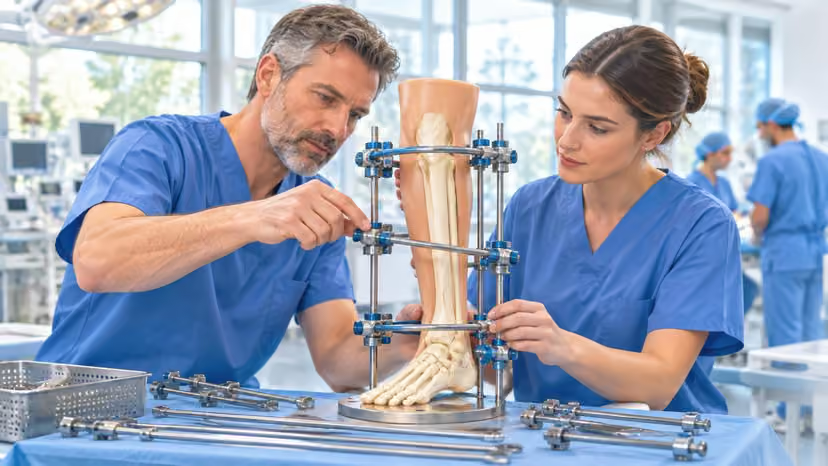
Temporary stabilization can play an important role when a fracture needs more than a single, immediate procedure. In high-energy trauma, open injuries, severe swelling, contamination, vascular concerns, or unstable patient conditions, the first priority may be protecting injured soft tissues while creating a safer route toward definitive care.
We view staged fracture care as a coordinated clinical process, not a fixed formula. For orthopedic surgeons, trauma teams, operating room staff, and distributors, the process depends on surgeon-led judgment, reliable devices, compatible instruments, and a clear plan for reassessment at every stage.
Protect Soft Tissues While Building a Safer Care Path
Immediate internal fixation is not always the right first step. When tissues are swollen, damaged, contaminated, or difficult to assess, definitive reconstruction may need to wait until the treating team determines that conditions are more suitable. This is especially relevant when the injury involves an open wound, complex bone damage, circulation concerns, or other trauma that affects the patient’s overall condition.
An external fixation system may serve as a temporary bridge during this period. It can help maintain limb length and alignment while allowing clinicians to access wounds, monitor the skin, and continue evaluating the patient. The right approach always depends on the fracture pattern, imaging findings, patient physiology, and the protocols followed by the treating institution.
From our perspective as a manufacturer and supplier of orthopedic solutions, equipment is only one part of the pathway. Successful staged care also calls for skilled clinical assessment, appropriate implant selection, dependable instruments, and organized follow-up from emergency management through definitive reconstruction.
Recognize When Staged Fracture Care Adds Value
Staged care may be considered when immediate definitive fixation could place additional stress on already injured tissues or when the patient needs further evaluation before a longer procedure. The purpose is not to delay treatment without reason. Instead, it is to create safer conditions for reconstruction when the surgical team believes the time is right.
Situations that may lead a treating team to consider a staged pathway include:
- Complex fractures near a joint
- Polytrauma cases involving multiple injuries
- Open fractures requiring wound assessment and management
- Fractures with major swelling or compromised skin condition
- Injuries that may require repeated soft-tissue review
Early stabilization goals can vary, but they often include provisional alignment, reduced motion at the fracture site, safer transport, and improved access for wound care or imaging. The external fixation construct should reflect the fracture location, bone quality, expected duration of use, and the surgeon’s plan for definitive treatment.
Clear communication keeps this process on track. Trauma surgeons may coordinate with anesthesiology, nursing, vascular or plastic surgery specialists, imaging teams, and rehabilitation professionals. When teams document treatment goals, expected reassessment points, and escalation criteria, everyone has a clearer understanding of what needs attention before the next stage of care.
Choose an External Fixation System That Fits the Injury
No two injuries present exactly the same way, which is why construct flexibility matters. A well-designed external fixation system should give clinicians options that fit different anatomical regions and fracture patterns. Rod configurations, clamps, pins, connecting elements, and radiolucent components may all affect how a construct is planned and assembled.
During urgent cases, the surgical team needs equipment that supports focused, efficient work. Dependable mechanical performance, intuitive instrumentation, organized sterile packaging, and clear implant identification can help staff concentrate on reduction goals and soft-tissue protection rather than sorting through avoidable equipment issues.
For facilities and distributors, product evaluation should go beyond individual components. We recommend considering the full support structure around the system, including:
- Consistent inventory and replacement-component availability
- Instrument compatibility and sterile workflow support
- Training materials and approved instructions for use
- Regulatory documentation and product traceability
- Responsive technical resources for clinical teams
At Stahlmann Pro, we manufacture and supply orthopedic implants, surgical instruments, trauma solutions, spine systems, craniomaxillofacial implants, and power tools for healthcare professionals and distributors. We believe reliable product support, traceability, and technical information should stand alongside precision-engineered device design.
Plan the Move to Definitive Fixation with Confidence
Temporary stabilization should begin with the next stage in mind. Throughout external fixation, the treating team may review swelling, skin condition, wound status, neurovascular findings, signs of infection, imaging, and the patient’s overall physiology. Those findings can affect whether the plan moves toward internal fixation, reconstruction, continued external stabilization, or another surgeon-directed approach.
Thoughtful pin placement is particularly important from the beginning. Whenever possible, pin locations should avoid anticipated surgical approaches and planned implant paths for definitive treatment. This requires the clinical team to consider incision sites, soft-tissue injury zones, likely fixation methods, and the anatomy involved before placing the initial construct.
Readiness for transition also depends on practical coordination. Imaging review, operating room scheduling, implant availability, infection prevention measures, and patient counseling should all be addressed before definitive treatment. A calendar alone should never dictate conversion timing. The treating surgeon and multidisciplinary team should determine the appropriate timing based on the patient’s changing clinical picture.
Reduce Complications Through Coordinated Follow-Up
Regular review while an external fixation system is in place can help teams identify concerns early. Follow-up plans may include assessment of alignment, pin sites, pain, mobility, neurovascular status, wound condition, and imaging when the clinical team finds it appropriate. The exact schedule and care instructions should remain tailored to the individual patient and treatment plan.
Patients and caregivers also need plain, practical guidance. They should understand mobility limits, weight-bearing instructions, hygiene expectations, scheduled review visits, and warning signs that require urgent attention. Explaining why temporary stabilization is being used can help people understand that each stage has a purpose.
System-level habits matter as well. We support the use of consistent documentation, device traceability, staff education, and clear processes for inspecting and maintaining instruments. Manufacturers and distributors can contribute by providing accurate product information, training resources, technical support, and dependable access to compatible components when needed.
Put a Reliable Staged Care Protocol Into Practice
Before an urgent injury occurs, orthopedic and trauma teams can review how external fixation fits into their existing fracture-care pathway. Clarifying indications, team responsibilities, inventory needs, escalation steps, and transition planning can reduce uncertainty when rapid decisions are required.
A reliable staged protocol keeps the focus where it belongs: protecting soft tissues, maintaining appropriate stabilization, reassessing the patient carefully, and moving to definitive treatment only when the treating team determines that conditions support that next step.
Support Confident Clinical Decision-Making
At Stahlmann Pro, we offer an external fixation system designed to support adaptable trauma care workflows. Our product range helps clinical teams access dependable fixation solutions for complex fracture management needs. To discuss product availability or specifications, contact us today.
Frequently Asked Questions
What is staged fracture care?
Staged fracture care is a treatment approach that uses temporary stabilization before definitive fracture repair. It may be used when swelling, soft-tissue damage, contamination, or a patient’s overall condition makes immediate internal fixation less suitable.
When is external fixation used for a fracture?
External fixation may be used when a fracture needs temporary stabilization while clinicians assess wounds, swelling, circulation, or other injuries. It is commonly considered for open fractures, high-energy trauma, polytrauma, complex fractures near joints, and injuries with compromised skin.
How does an external fixator help protect soft tissues?
An external fixator can help maintain limb length and alignment without placing implants directly at the fracture site during the initial stage of care. This can provide access for wound care, skin monitoring, imaging, and repeated soft-tissue assessment.
What is the difference between temporary external fixation and internal fixation?
Temporary external fixation stabilizes a fracture using pins, clamps, rods, and connecting components outside the body. Internal fixation uses implants such as plates, screws, or nails placed inside the body, often as the definitive method once conditions are appropriate.
How do surgeons choose an external fixation system for a fracture?
Surgeons select an external fixation construct based on the fracture location, fracture pattern, bone quality, soft-tissue condition, and expected duration of temporary stabilization. They also consider whether the system provides the needed clamps, rods, pins, instrumentation, and imaging access for the planned treatment pathway.
