
Mini Fragment External Fixator: Design, Components and Buying Guide
A Mini Fragment External Fixator is a compact external fixation device. The design described here uses two bars, a movable body and adjustable clamps, with 2 mm Schanz screws. Its compact arrangement is intended for confined working spaces. Clinical applications and component compatibility must follow the device’s instructions for use.
For clinicians, understanding the component arrangement helps support product evaluation. For hospitals and orthopedic distributors, a clear specification helps distinguish the required device from instruments, replacement components and other fixation systems.
This guide focuses on the two-bar mini fixator design, its screw interface and the information needed before purchasing. It also answers common questions about external fixation, removal and treatment terminology.
What Makes This Mini Fragment External Fixator Different?
The Mini Fragment External Fixator described here has a compact arrangement built around two bars, a movable body and clamps associated with DC discs.
The supplied design description identifies three main characteristics:
- A two-bar supporting structure.
- A movable body and adjustable clamp arrangement.
- Use with 2 mm diameter Schanz screws.
The design is described as allowing access in narrow spaces and permitting Schanz screw positioning parallel to a joint surface, subject to the applicable surgical technique.
These characteristics describe the device’s construction. They do not establish a universal indication, guarantee a particular clinical result or replace assessment by the treating surgeon.
When reviewing this mini fragment system, buyers should identify the exact configuration rather than rely on the word “mini.” That term does not establish a standardized set of dimensions across different products.
How Does the Two-Bar Mini Fixator Work?
The two bars form the device’s external supporting structure. The movable body and clamps provide the arrangement through which the specified components are positioned and secured.
Compatible Schanz screws form the bone attachment interface. The device’s adjustment and locking requirements must be established from its technical documentation.
| Component | Description |
|---|---|
| Two bars | Main external supporting structure |
| Movable body | Central component within the described assembly |
| Clamps | Adjustable components positioned on the bars |
| DC discs | Components identified in the supplied design description |
| Schanz screws | Specified with a 2 mm diameter |
Understanding the role of each part helps make an enquiry more precise. For example, a request for an additional clamp is different from a request for a complete mini fixator assembly.
The term “DC discs” should be checked against the current component list. Its name alone should not be interpreted as proof of a particular compression or distraction capability.
Which Schanz Screws Does the Mini Fragment External Fixator Use?
The supplied specification identifies 2 mm diameter Schanz screws. This measurement refers to the screws, not the supporting bars. Complete screw selection also requires confirmation of length, thread configuration, clamp interface and associated instruments. A matching nominal diameter alone does not establish compatibility with another system.
When preparing an order, request the screw dimensions separately from the frame dimensions.
Important details include:
- Nominal screw diameter.
- Available overall lengths.
- Threaded length and thread design.
- Compatible clamp references.
- Required insertion instruments.
- Whether screws are included or supplied separately.
Do not assume that all 2 mm pins, wires and Schanz screws serve the same purpose. The exact component identification should remain consistent between the quotation, supplied labeling and system documentation.
Which Product Specifications Should Buyers Review?
A specification table helps separate the information already available from the details that need confirmation for an order.
| Specification | Product information |
|---|---|
| Product name | Mini Fragment External Fixator |
| Supporting structure | Two bars |
| Body arrangement | Movable body |
| Clamp arrangement | Movable clamps associated with DC discs |
| Schanz screw diameter | 2 mm |
| Design characteristic | Compact arrangement for confined working spaces |
| Screw-positioning feature | Described as permitting positioning parallel to the joint surface, subject to the applicable technique |
| Bar dimensions | Request confirmed diameter and length |
| Material and grade | Request product-specific information |
| Adjustment range | Confirm technical specification |
| Instruments | Confirm matching instrument requirements |
| Package contents | As identified in the itemized quotation |
| Supplied condition | Check product labeling |
| Processing and reuse | Follow component-specific instructions |
A clear table also supports repeat purchasing. Once the required configuration has been confirmed, retain its component references and dimensions for future enquiries.
Product specifications should come from the current documentation. They should not be inferred from the color, finish or apparent size of a photograph.
How Do Modular, Monolateral and Uniplanar Fixators Differ?
These terms describe different characteristics of external fixation.
A modular external fixator uses components assembled into a selected configuration. A monolateral external fixator generally has its supporting structure along one side of the limb. A uniplanar external fixator describes an arrangement in one plane.
The phrase unilateral uniplanar external fixator combines descriptions of side and plane. It should not be treated as an automatic label for every compact device.
AO Surgery Reference explains modular fixation through partial frames connected into a complete construct. That general description should not be used to assign undocumented features to a particular mini fixator.
For wider background, read the External Fixation System guide.
What Are the Three Types of External Fixators?
Three commonly described types of external fixators in orthopaedics are monolateral, circular and hybrid configurations. Some references group systems primarily into monolateral and circular designs. These categories describe frame architecture and do not determine the intended use of an individual product.
A mini fixator should therefore be evaluated through its own specifications. Its compact appearance does not establish that it belongs to every category or offers the same configuration options as a larger frame.
What Should Be Confirmed for Upper Limb Applications?
When evaluating an upper limb external fixator, the intended anatomical application should come from the selected device’s instructions.
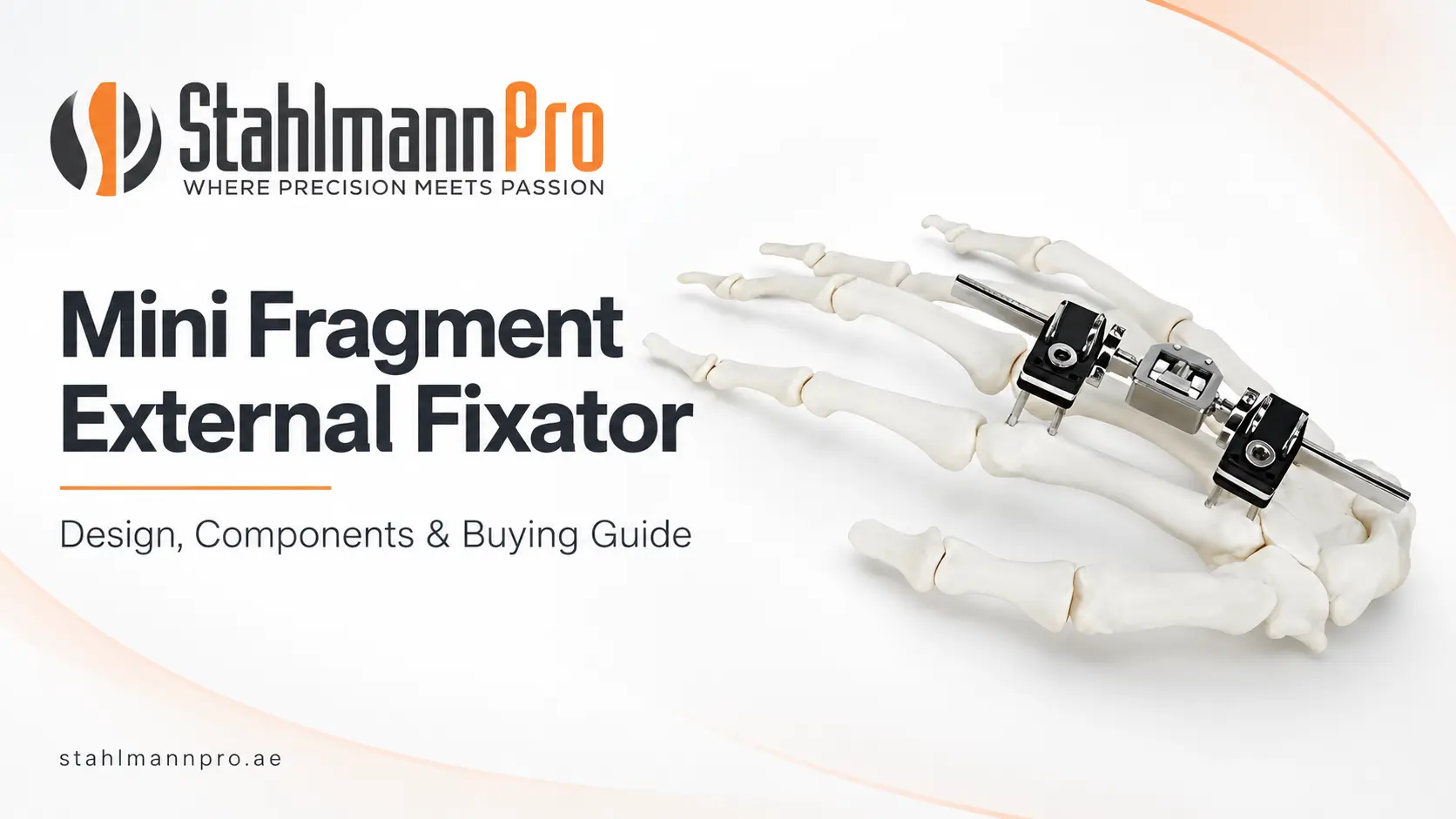
The product illustration shows this mini fixator on a hand-bone model. It provides a view of the device arrangement, but it does not establish approval for every hand, wrist or finger condition.
Clinical evaluation should consider the intended application and the documented capabilities of the device. Purchasing teams should work from the configuration requested by the clinical team.
A dedicated mini fixator should also be distinguished from the Hoffmann-Type External Fixation Small Fragment Set. These are separate product options with their own component and instrument requirements.
How Do External and Internal Mini Fragment Systems Differ?
A mini fragment system may refer to an external fixation device or an internal plate-and-screw system. The complete product name matters because these approaches use different components.
| Feature | External mini fixation | Internal mini fragment fixation |
|---|---|---|
| Main supporting structure | Outside the body | Internal implants |
| Typical components | External body, bars, clamps and bone attachments | Plates, screws or other specified implants |
| Component selection | Based on the external device configuration | Based on the internal implant system |
| Instruments | Matched to the selected external system | Matched to the selected internal system |
Internal fixation includes implants such as plates, screws, nails and wires. An external frame connects to bone through attachments that pass through the skin. The clinical choice requires individual assessment.
Which Instruments and Accessories Should Be Included?
Before ordering, establish whether the quotation covers the device only or a complete package with screws and instruments.
Ask for an inventory identifying:
- The assembled mini fixator or separate frame components.
- Compatible Schanz screws and quantities.
- Required insertion and tightening instruments.
- Any guides or accessories specified for the system.
- Storage or instrument trays, where included.
- Applicable handling and processing documentation.
An instrument’s appearance does not establish compatibility. Confirm its interface and intended task against the selected device.
For replacement purchases, provide the existing component identification. This helps distinguish an additional screw, replacement clamp or complete replacement assembly.
What Determines the Mini External Fixator Price?
The external fixator price depends on the quoted configuration, quantities, screws, instruments and accessories. A device-only quotation should be distinguished from a complete package. Meaningful price comparisons require the same itemized specification, including the supplied components and any separately quoted requirements.
The term external fixator cost can also refer to the wider cost of treatment. Surgery, anesthesia, hospital care and follow-up are separate from the purchase price of the device.
Hospitals and distributors should make the purchasing scope clear. If an enquiry concerns supply only, state the required device quantity and accompanying components.
A photograph may show several parts together, but the quotation should identify exactly what is supplied.
What Should Buyers Check Before Ordering?
A structured enquiry reduces uncertainty during product evaluation.
How Can Buyers Define the Required Configuration?
Start with the exact product name and the requested quantity. Confirm the two-bar arrangement and required screw specification.
Include any requirements for additional screws, instruments or replacement components. Where a technical drawing is available, use its revision to identify the configuration under review.
Which Documents Should Buyers Request?
Request the documents relevant to the selected device and destination, including:
- Product specifications.
- Component inventory.
- Applicable instructions for use.
- Material information.
- Supplied condition and processing information.
- Product identification and traceability details.
- Relevant quality and regulatory documentation.
Documentation should be reviewed for the actual product being ordered. A general company document does not automatically answer every device-specific question.
What Should Distributors in Latin America, Africa and Russia Specify?
Hospitals and distributors in Latin America, Africa and Russia should identify the destination country when requesting product information.
Language, labeling and purchasing requirements vary between markets. An enquiry should state the documents and language needed for local review rather than assuming one package suits every destination.
Quotations should clearly identify their currency. Where a local budget uses another currency, keep the conversion date and calculation separate from the supplier’s quoted amount.
For repeat orders, retain the confirmed configuration and itemized inventory. This makes it easier to distinguish stock replenishment from requests for a different device.
What Questions Do Patients Ask About External Fixation?
Patients may encounter the term “mini fixator” alongside broader external fixation information. General education can help prepare questions, while individual treatment decisions remain with the clinical team.
What Is Ex Fix Surgery?
“Ex fix surgery” is shorthand for external fixation surgery. It involves connecting bone attachments to a supporting structure outside the body. The purpose may be temporary stabilization or definitive treatment, depending on the injury and clinical plan. The precise procedure varies with the selected device.
How Long Can an External Fixator Stay On?
There is no universal external fixator removal time. Duration depends on the treatment purpose and assessment of progress. Follow-up examinations and any required imaging help the treating team decide when removal or a change in treatment is appropriate. Patients should follow their individual plan.
What Is the Most Serious Disadvantage of an External Fixator?
Infection is an important concern because bone attachments pass through the skin. A superficial infection may become serious if it spreads deeper. Other complications can also be significant, so no single disadvantage is the most serious for every patient. Individual risks require clinical discussion.
How Painful Is External Fixator Removal?
Removal can cause discomfort or pain. The experience depends on the device, attachment sites and removal method. The treating team plans pain relief or anesthesia and should explain the arrangements beforehand. Patients should ask where removal will take place and what aftercare will be needed.
What Other Questions Should Buyers Ask?
Is the Mini Fragment External Fixator Supplied With Schanz Screws?
Check the itemized quotation. The specified 2 mm screw diameter does not establish the number of screws included with an order.
Does the 2 mm Measurement Refer to the Bars?
No. In the supplied description, 2 mm refers to the Schanz screw diameter. Bar dimensions require separate confirmation.
Can Components From Another Mini Fixator Be Used?
Compatibility should not be assumed. Confirm the approved screw, clamp and instrument combinations for the selected device.
Is This the Same as a Mini Fragment Plate System?
No. This page describes an external device with bars, a movable body and clamps. Internal mini fragment systems use their own implants and instruments.
Can the Device Be Reused?
Follow the labeling and applicable processing instructions for each component. Do not infer reuse status from its appearance.
Can Buyers Order Replacement Components?
Include the existing device identification and the required component in the enquiry. Request confirmation of availability and compatibility before ordering.
How Can Hospitals Buy a Mini Fragment External Fixator?
To buy a Mini Fragment External Fixator, provide the required quantity, screw requirements, instruments and destination country. Request an itemized quotation with specifications and documentation. Identify whether the enquiry concerns a complete device, additional Schanz screws or replacement components.
Stahlmann Pro welcomes enquiries from hospitals, orthopedic distributors and procurement teams in Latin America, Africa and Russia.
Explore the External Fixation System range or contact Stahlmann Pro to request a Mini Fragment External Fixator quotation, current availability and product information.
Email: info@stahlmannpro.ae
Phone / WhatsApp: +971 50 975 0822
This article provides general product information and education. Clinical selection, application and removal must follow the device instructions and treating team’s assessment.
