
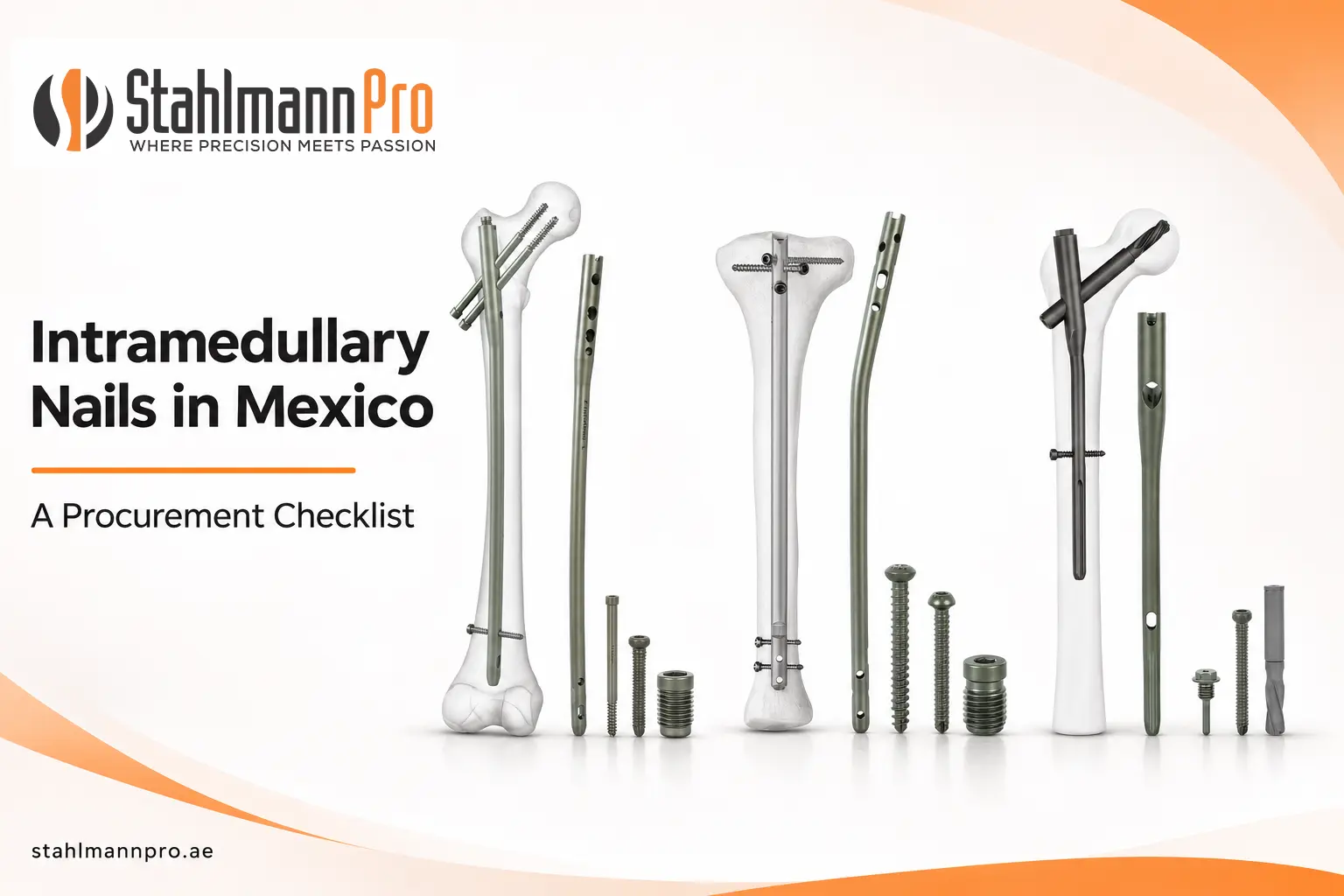
Intramedullary Nails in Mexico: A Procurement Checklist for Hospitals and Distributors
Buying intramedullary nails in Mexico starts with a documented system specification: the required implant family, catalogue codes, dimensions, compatible locking components, instrument set and supply condition. Before placing an order, purchasing teams should also establish who will verify the applicable Mexican registration, import and labeling requirements. A quotation becomes useful when the products, supporting documents and delivery responsibilities are clear enough to check line by line.
For a hospital purchasing department or orthopedic distributor, the main challenge is translating a clinical request into an order that the supplier, importer, receiving team and operating department understand in the same way. This guide provides a practical workflow for that task. It does not select an implant for an individual patient; that decision belongs to the treating clinical team using the relevant product instructions.
1. Define the Nailing System Before Comparing Suppliers
An enquiry for “a femoral nail” leaves too much open to interpretation. Start with the system name and intended application confirmed by the orthopedic team. A request for a femoral system, a tibial system or a proximal femoral system should identify the particular product family under consideration.
In bilingual purchasing records, pair the Spanish description with the supplier’s English catalogue description. For example, record clavo femoral alongside the exact product name and code. This helps different departments identify the same item without relying on an informal translation.
The Stahlmann Pro intramedullary nailing system catalogue is a starting point for product enquiries. Ask for current specifications for the selected model rather than assuming that every item in the category has the same features, materials or instruments.
Build a purchasing specification
Record the model, catalogue reference, requested length and diameter, material designation, quantity and associated components. Add laterality, entry configuration or other design distinctions wherever the selected system requires them. Leave uncertain fields marked for clarification instead of choosing a value to complete the form.
Clinical approval should come before commercial comparison. Otherwise, suppliers may price different configurations, making the cheapest offer appear equivalent when it covers a different scope.
2. Request a Complete Implant and Instrument List
Treat the enquiry as a system purchase. Ask which locking screws, end caps and accessories belong to the quoted configuration and which are supplied separately. Request the instrument list for that exact model, including the instruments needed for insertion and any manufacturer-specified removal components.
Do not assume that an existing hospital instrument set will fit a new nail. Similar appearance, matching nominal dimensions or a supplier’s broad statement about “standard compatibility” is insufficient for a purchasing decision. Request written compatibility information tied to the product references.
AO Surgery Reference explains that proximal femoral nail design affects the intended entry point and that the surgeon must understand the selected system. For procurement, the practical implication is to obtain the correct system documentation and ensure that clinical staff can review it before adoption. [1]
Make the quotation easy to reconcile
| Purchasing item | Information to request |
|---|---|
| Main implant | Product family, reference, dimensions, material and quantity |
| Locking components | Compatible references, size options and quantities |
| Accessories | Included items and separately priced components |
| Instruments | Itemized set list and model compatibility |
| Documentation | Current instructions and relevant technical records |
| Supply condition | Sterile or nonsterile status and packaging details |
| Support | Contact for missing, damaged or disputed items |
Use the same table for every supplier. Differences then become visible without comparing several differently formatted brochures.
3. Establish the Mexican Documentation Route Early
Separate the supplier’s technical documents from the records needed for the intended Mexican market activity. A product brochure answers what is offered; it does not establish that a particular model is authorized for sale or that an importer has completed the relevant steps.
COFEPRIS publishes an official medical-device registration procedure. Its listed requirements cover technical information and supporting records for domestic and foreign-manufactured devices. Have the responsible Mexican party verify the route and documents applicable to the exact product and transaction. [2]
Request a clear answer to three questions: which legal entity is responsible for the local process, which product references are covered, and what evidence can be reviewed before the commercial commitment. Avoid treating a broad product-family description as proof that every size or configuration is included.
This article does not establish Mexican registration or authorization for any Stahlmann Pro product. Confirm product-specific status directly before purchase or distribution.
4. Plan Labeling and Traceability Together
Mexico’s published NOM-137-SSA1-2025 addresses medical-device labeling. The text includes provisions for identification, lot or serial information and other device-specific details. It also addresses Spanish-language information and supplementary labeling. The responsible local team should confirm the applicable requirements and transition provisions for the intended supply. [3]
Build receiving records that connect the order reference, delivered product, package identification and supplier paperwork. Useful purchasing terms include número de lote for lot number and trazabilidad for traceability. Keep the supplier’s original identifiers alongside translated field names.
A readable package label is only one part of this workflow. The hospital or distributor must also be able to retrieve its own receiving record later. As a practical purchasing measure, agree how discrepancies and lot-specific enquiries will be communicated before delivery.
5. Confirm Sterile or Nonsterile Supply
Ask the supplier to state the supply condition for every relevant item. Do not infer sterility from a sealed pouch, a product photograph or the general presentation of a catalogue. Request the current instructions and packaging information for the quoted references.
Have the hospital’s responsible team review any required preparation or processing instructions before accepting a new system into its workflow. Procurement should record the decision and the documents reviewed rather than inventing a processing method or copying one from another product.
When comparing offers, keep implants and reusable instruments separate. Their documentation, handling and lifecycle responsibilities may differ. A commercially complete offer should make those distinctions visible, including any items that need separate arrangements before clinical use.
6. Agree the Stock Mix With the Clinical Team
A distributor’s opening order should reflect an agreed product range and replenishment plan. Avoid buying a large assortment simply because it appears comprehensive. Equally, a narrow stock list should not be presented as sufficient for every case.
Ask clinical stakeholders to identify the configurations they want available, the alternatives they expect and the items that require special ordering. Record who approves substitutions. Purchasing staff should not replace an unavailable component with another brand or model without the required technical and clinical confirmation.
For a business serving several locations, separate warehouse stock from hospital-held or consignment stock. Define how usage reports, returns and replenishment requests will be reconciled. These are commercial arrangements to agree explicitly, not services implied by a supplier’s catalogue.
7. Compare the Total Quoted Scope
An intramedullary nail quotation should show more than the price of the main implant. Ask for separate lines covering associated components, instruments, packaging, documentation support and shipping. Identify any charges or responsibilities excluded from the offer.
For delivery to Mexico, agree the destination, commercial terms and allocation of customs-related responsibilities. Request a delivery estimate tied to the actual order configuration. A general statement about fast international shipping does not establish stock availability or a confirmed arrival date.
Compare offers only after aligning their scope. One quotation may include an instrument set while another prices implants alone. A low unit price can be useful, but it cannot answer whether the full requested order is covered.
8. Use a Written Receiving and Discrepancy Process
Before shipment, nominate the receiving contact and share the approved order list. On arrival, reconcile delivered references and quantities against the purchase order and packing information. Record discrepancies, damaged packaging and identification questions through the facility’s established quality process.
Agree a supplier contact for resolution and retain the correspondence with the order record. Do not silently relabel a disputed item, substitute a component or release an unresolved delivery solely to meet a scheduled date.
This workflow is particularly useful when purchasing, warehouse and clinical teams use different systems. A simple shared order reference can connect their records without replacing the facility’s own quality procedures.
Set responsibilities before the first delivery
Assign an owner for each unresolved question. The clinical lead can confirm the requested configuration; purchasing can reconcile prices and quantities; the responsible Mexican regulatory party can review the local documentation route; and receiving staff can record delivery discrepancies. These roles may sit within different organizations, so name the actual contacts in the order file.
Consider a hypothetical quotation that lists the requested nail sizes but says only “instrument set included.” Before approval, ask for the set reference, inventory list and compatibility information. If the supplier provides those details, attach the response to the quote. If the answer remains unclear, record the point as unresolved rather than treating the phrase as evidence of completeness.
The same approach applies when an offer says “documentation available.” Specify which documents are needed, who must review them and when they must arrive. A promised document and a reviewed document are different milestones. This distinction makes the purchasing decision easier to explain and helps prevent unresolved questions from being passed silently to the receiving team.
9. Send an Enquiry That Can Produce a Useful Answer
For enquiries to Stahlmann Pro, start with the intramedullary nailing system category and identify the product family you want to discuss. Include requested sizes, quantities, instrument requirements and the Mexican delivery destination.
Explain whether you are comparing a first purchase, expanding an existing range or seeking replenishment. Ask the team to confirm current product information, compatible components, available documentation and the commercial scope. Any market-specific authorization or delivery claim should be supported for the actual enquiry.
You can also review the broader trauma implants portfolio when discussing related purchasing needs. Keep each product family’s specifications separate so that information from one system is not applied to another.
Enquiry wording
“Please provide a quotation for the specified intramedullary nailing system for delivery to Mexico. Include catalogue references, requested sizes and quantities, compatible locking components, an itemized instrument list, supply condition, current instructions, available product-specific documentation, estimated dispatch timing and shipping terms. Please identify exclusions and any points requiring clarification.”
Attach the approved specification sheet. A precise first enquiry reduces follow-up about missing sizes, unclear components or instruments that were never included in the price.
Frequently Asked Questions
What should I check before buying intramedullary nails in Mexico?
Confirm the exact system, catalogue references, dimensions, compatible components, instruments and supply condition. Establish who will verify the applicable Mexican regulatory and import requirements. Then compare complete quotations against the same specification.
Are femoral and tibial nail instrument sets interchangeable?
Do not assume interchangeability. Request compatibility documentation for the exact implant model and instrument references. The clinical team should review the proposed combination before procurement accepts it as suitable.
Does an international certificate prove Mexican registration?
A certificate should be assessed for what it actually covers. Do not treat it alone as proof of Mexican product registration. Ask the responsible local party to verify the applicable COFEPRIS status and supporting records for the proposed product.
What does clavo intramedular mean in a quotation?
It is the Spanish term for an intramedullary nail. Use it alongside the manufacturer’s specific product description and reference, because the general term does not identify a particular model, size or complete system.
How should a hospital choose its initial size range?
The orthopedic team should define the requested range and alternatives based on its service needs and the selected system. Procurement can then document quantities, replenishment arrangements and any special-order items without making patient-specific implant choices.
Can I order implants without buying an instrument set?
Ask what the supplier offers and document the scope. If the hospital intends to use existing instruments, obtain confirmation of compatibility with the selected implant references. An implant-only price does not confirm instrument availability or suitability.
How can I request an intramedullary nail quotation from Stahlmann Pro?
Send the product family or catalogue references, sizes, quantities, instrument needs and delivery destination through the Stahlmann Pro contact page. You can also email info@stahlmannpro.ae or call +971 50 975 0822. Ask for current specifications and documentation for the proposed configuration.
