
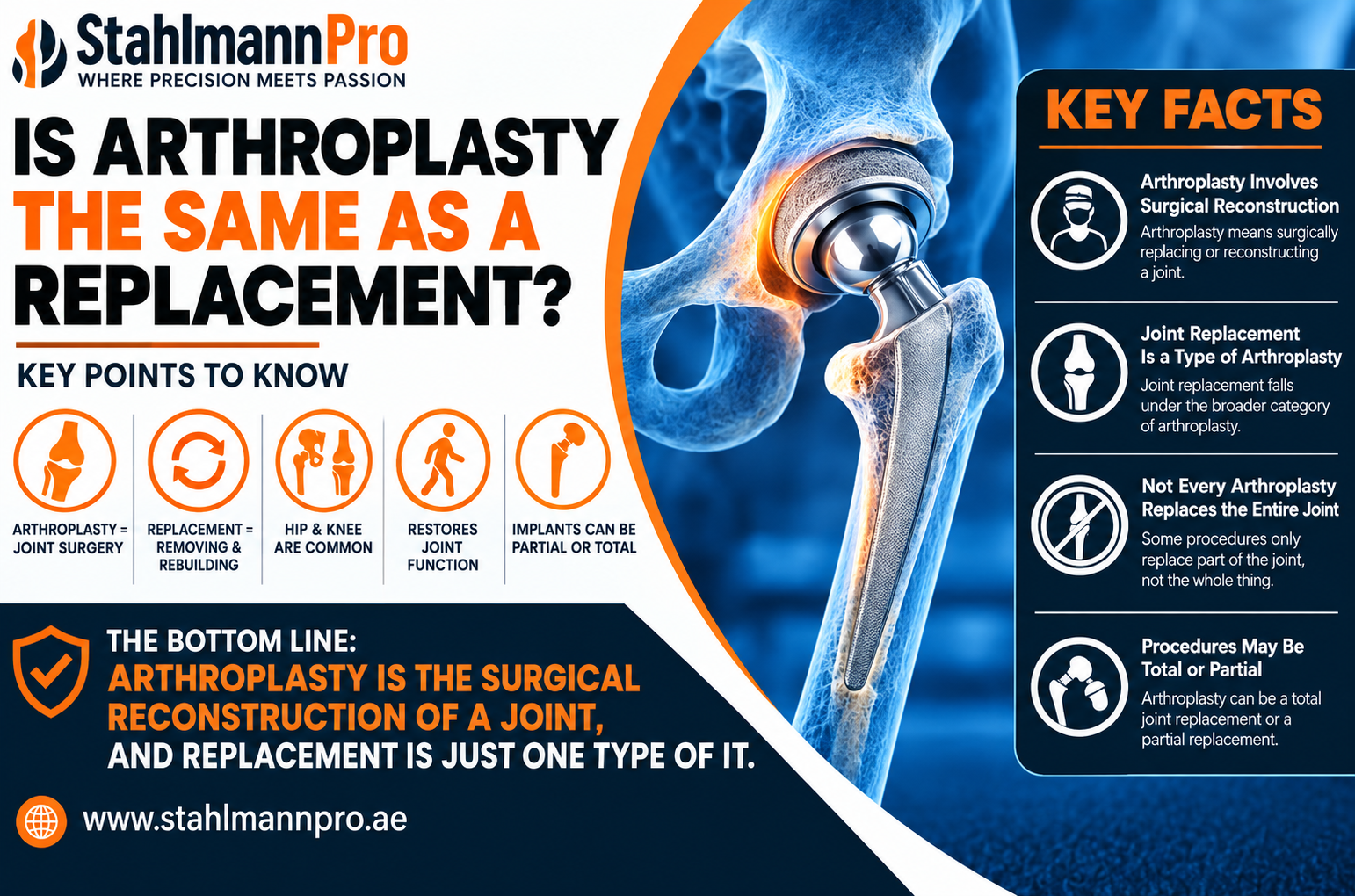
Arthroplasty and joint replacement are terms that are often used interchangeably, but they do not always mean exactly the same thing. Both relate to surgical procedures designed to restore joint function, reduce pain, and improve mobility. However, arthroplasty is a broader medical term that can include different types of procedures, while joint replacement specifically refers to replacing part or all of a damaged joint with an artificial implant.
Understanding the difference can make it easier for patients, healthcare students, and medical professionals to understand treatment options and surgical terminology.
What Is Arthroplasty?
Arthroplasty is a surgical procedure performed to repair, reconstruct, reshape, or replace a joint. The primary goal is to improve joint movement and reduce symptoms caused by damage, disease, injury, or degeneration.
The word arthroplasty comes from terms referring to joint and surgical repair. Depending on the condition and joint involved, arthroplasty may involve removing damaged tissue, reshaping the joint surfaces, or using an implant to restore the joint.
Arthroplasty can be performed on several joints, including the:
- Hip
- Knee
- Shoulder
- Elbow
- Ankle
- Wrist
The exact procedure depends on the patient’s condition, the extent of joint damage, and the treatment plan selected by the orthopedic surgeon.
Is Arthroplasty the Same as Joint Replacement?
Not necessarily. Joint replacement is a type of arthroplasty.
When a damaged joint is partially or completely replaced with artificial components, the procedure is commonly called joint replacement or replacement arthroplasty. However, arthroplasty can also describe procedures where the joint is repaired or reconstructed without completely replacing it.
For example, a total knee replacement is a form of arthroplasty because damaged portions of the knee joint are replaced with prosthetic components. On the other hand, certain reconstructive arthroplasty procedures may reshape or repair joint surfaces without replacing the entire joint.
Therefore, the terms are closely related, but arthroplasty has a broader meaning.
What Is Joint Replacement?
Joint replacement is a surgical procedure in which damaged parts of a joint are removed and replaced with artificial components. These components are designed to reproduce normal joint movement as closely as possible.
A joint replacement may be:
Total replacement:
The damaged joint surfaces are replaced with prosthetic components.
Partial replacement:
Only the damaged portion of the joint is replaced while some healthy joint structures remain.
The choice between partial and total replacement depends on factors such as the location and severity of joint damage, surrounding bone and tissue condition, activity level, and the surgeon’s assessment.
Common Types of Replacement Arthroplasty
Total Hip Arthroplasty
Total hip arthroplasty, commonly called total hip replacement, replaces damaged components of the hip joint with prosthetic parts. It is frequently used when severe arthritis or other conditions cause persistent pain and reduced mobility.
The artificial joint generally includes components designed to replace the damaged femoral head and the affected socket surface.
Total Knee Arthroplasty
Total knee arthroplasty replaces damaged surfaces of the knee joint with prosthetic components. It may be considered when advanced joint degeneration causes significant pain, stiffness, and difficulty performing everyday activities.
The procedure aims to create smoother joint movement and improve functional ability.
Shoulder Arthroplasty
Shoulder arthroplasty can involve replacing one or more damaged surfaces of the shoulder joint. Depending on the condition, surgeons may perform anatomic shoulder replacement or a reverse shoulder replacement.
The appropriate technique depends on the patient’s anatomy, joint damage, and condition of the surrounding structures.
Why Is Arthroplasty Performed?
Arthroplasty may be considered when joint damage significantly affects comfort and function and other treatment options have not provided sufficient improvement.
Common reasons for arthroplasty include:
- Osteoarthritis
- Rheumatoid arthritis
- Severe joint degeneration
- Certain fractures
- Joint deformities
- Damage caused by previous injury
- Some other conditions affecting joint function
The decision to undergo surgery is individualized and should be made with an appropriately qualified orthopedic specialist.
What Happens During Joint Replacement?
The details vary according to the joint and surgical technique, but replacement arthroplasty generally involves several stages.
First, the surgeon accesses the affected joint through an appropriate surgical approach. Damaged bone and cartilage are carefully removed or prepared. The surfaces are then shaped to accommodate the selected prosthetic components.
The artificial components are positioned to restore joint alignment and movement. Depending on the implant design and surgical plan, components may be fixed using different techniques.
After the procedure, the surgical team focuses on pain management, wound care, mobility, and rehabilitation. Physical therapy is often an important part of recovery.
Arthroplasty vs. Replacement: The Key Difference
The simplest way to understand the terminology is:
Arthroplasty = a broad term for surgical restoration or reconstruction of a joint.
Joint replacement = a type of arthroplasty involving replacement of damaged joint surfaces with prosthetic components.
This means every joint replacement can be described as an arthroplasty, but not every arthroplasty necessarily involves complete joint replacement.
What Are Arthroplasty Implants Made Of?
Joint replacement systems can use different materials depending on the joint, implant design, and manufacturer. Common materials include medical-grade metals, ceramics, and highly durable polymers.
For example, some implant systems use metal components combined with polyethylene bearing surfaces. Ceramic materials may also be used in certain hip replacement designs.
The choice of implant depends on factors such as joint anatomy, surgical requirements, patient characteristics, and the surgeon’s preferred system.
Recovery After Arthroplasty
Recovery varies considerably depending on the type of arthroplasty, the patient’s overall condition, and the surgical technique.
Rehabilitation may include guided exercises, physical therapy, gradual increases in activity, and follow-up appointments. Patients are typically given specific instructions regarding movement, weight-bearing, wound care, and activities during recovery.
Following the prescribed rehabilitation program can help support mobility and functional recovery.
Frequently Asked Questions
Is arthroplasty always a joint replacement?
No. Arthroplasty is a broader term that includes surgical procedures intended to restore or reconstruct a joint. Joint replacement is one form of arthroplasty.
Is total knee replacement an arthroplasty?
Yes. Total knee replacement is also known as total knee arthroplasty, or TKA.
Is hip replacement called arthroplasty?
Yes. Total hip replacement is commonly called total hip arthroplasty, or THA.
What is the difference between partial and total arthroplasty?
Partial arthroplasty replaces or reconstructs only part of the affected joint, while total arthroplasty generally involves replacing the major damaged joint surfaces.
How long does an artificial joint last?
The lifespan of an implant varies depending on factors such as implant design, surgical technique, activity level, patient characteristics, and other clinical factors. Regular follow-up with an orthopedic specialist can help monitor the condition of a joint replacement.
Conclusion
Arthroplasty and joint replacement are closely connected terms, but they are not technically identical. Arthroplasty is the broader term for surgical restoration, reconstruction, or replacement of a joint, while joint replacement specifically involves replacing damaged joint surfaces with artificial components.
Understanding this distinction can make medical information about hip, knee, shoulder, and other joint procedures easier to interpret. Anyone considering arthroplasty should discuss the available surgical options, implant choices, expected recovery, and potential risks with a qualified orthopedic professional.
