
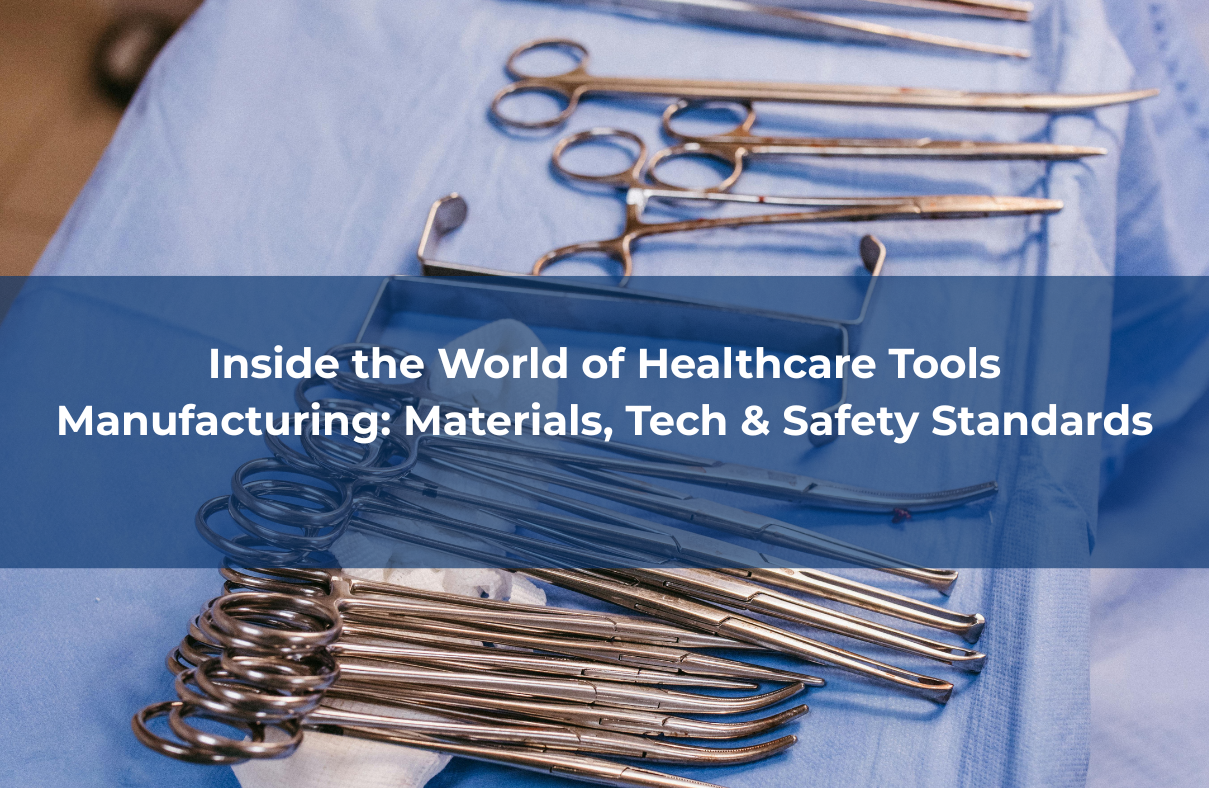
Healthcare tools manufacturing is one of the most tightly regulated and precision-driven industries in the world. From surgical instruments to advanced diagnostic devices, every product must meet strict safety, quality, and performance benchmarks.
Behind every medical tool lies a complex process involving specialized materials, advanced technologies, and globally recognized standards designed to protect patient lives.
The Importance of Precision in Healthcare Manufacturing
Medical tools are not ordinary products. They are used in life-critical situations where even minor defects can lead to serious consequences.
Manufacturers must ensure consistency, reliability, and traceability at every stage. This includes design, production, testing, and post-market monitoring.
Global standards exist to ensure that every device performs exactly as intended, every single time.
Materials Used in Healthcare Tools Manufacturing
The choice of material is one of the most critical decisions in medical manufacturing. Each material must meet strict safety and performance requirements.
Most healthcare tools are made from metals, polymers, and ceramics. Metals like stainless steel are widely used due to their strength and corrosion resistance.
Polymers offer flexibility and are commonly used in disposable devices. Ceramics are often used in implants due to their durability and compatibility with the human body.
One key requirement for all materials is biocompatibility. This ensures that the material does not cause harmful reactions when in contact with the human body.
Additionally, materials must be sterilizable, durable, and resistant to contamination to maintain safety in clinical environments.
The Role of Advanced Technology in Manufacturing
Modern healthcare tools are built using cutting-edge technologies that improve precision and efficiency.
Automation and robotics are widely used to reduce human error and maintain consistent quality. These systems allow manufacturers to produce highly complex components with extreme accuracy.
3D printing is also transforming the industry. It enables the creation of customized implants and tools tailored to individual patient needs.
Artificial intelligence and data analytics are increasingly used to monitor production quality and predict potential defects before they occur.
These technological advancements not only improve efficiency but also enhance patient safety.
Understanding Safety and Regulatory Standards
Safety is the foundation of healthcare manufacturing. Strict global standards ensure that every product meets regulatory requirements before reaching the market.
One of the most important standards is ISO 13485, which defines quality management systems for medical device manufacturers. It ensures consistent product quality and regulatory compliance.
Another key framework is ISO 14971, which focuses on risk management throughout the product lifecycle.
Standards such as ISO 10993 evaluate the biological safety of materials used in medical devices.
These standards are essential for ensuring that healthcare tools are safe, effective, and reliable.
Why Quality Management Systems Matter
A strong quality management system (QMS) is essential in healthcare manufacturing. It ensures that every process is controlled, documented, and continuously improved.
ISO-based systems help manufacturers track every stage of production. This includes raw material sourcing, assembly, testing, and distribution.
Quality systems also enable traceability. If an issue arises, manufacturers can quickly identify and resolve the problem.
This level of control is critical in an industry where safety cannot be compromised.
The Challenge of Compliance in a Global Market
Healthcare manufacturers must comply with multiple regulatory bodies across different regions.
For example, devices must meet FDA regulations in the United States and MDR requirements in Europe.
This creates a complex compliance landscape that manufacturers must navigate carefully.
However, global standards like ISO help harmonize these requirements, making it easier to maintain consistency across markets.
The Future of Healthcare Tools Manufacturing
The industry is evolving rapidly with new innovations shaping its future.
Smart medical devices, wearable health tech, and AI-powered diagnostics are becoming more common. These advancements require even stricter safety protocols and testing procedures.
Sustainability is also gaining importance. Manufacturers are exploring eco-friendly materials and energy-efficient production methods.
As technology continues to evolve, the focus will remain on improving patient outcomes while maintaining the highest safety standards.
Conclusion
Healthcare tools manufacturing is a highly specialized field where precision, safety, and innovation come together.
From selecting biocompatible materials to implementing advanced technologies and adhering to strict global standards, every step plays a vital role.
Understanding this process highlights the complexity behind the tools that healthcare professionals rely on every day.
FAQs
What materials are commonly used in healthcare tools manufacturing?
Metals, polymers, and ceramics are commonly used. These materials must be biocompatible, durable, and safe for medical use.
What is ISO 13485 and why is it important?
ISO 13485 is a global standard for quality management in medical device manufacturing, ensuring safety and regulatory compliance.
Why is biocompatibility important in medical devices?
Biocompatibility ensures that materials do not cause harmful reactions when they come into contact with the human body.
How does technology improve healthcare manufacturing?
Technologies like robotics, AI, and 3D printing enhance precision, reduce errors, and enable customized medical solutions.
What are the biggest challenges in healthcare manufacturing?
Regulatory compliance, maintaining quality standards, and ensuring product safety across global markets are major challenges.
