
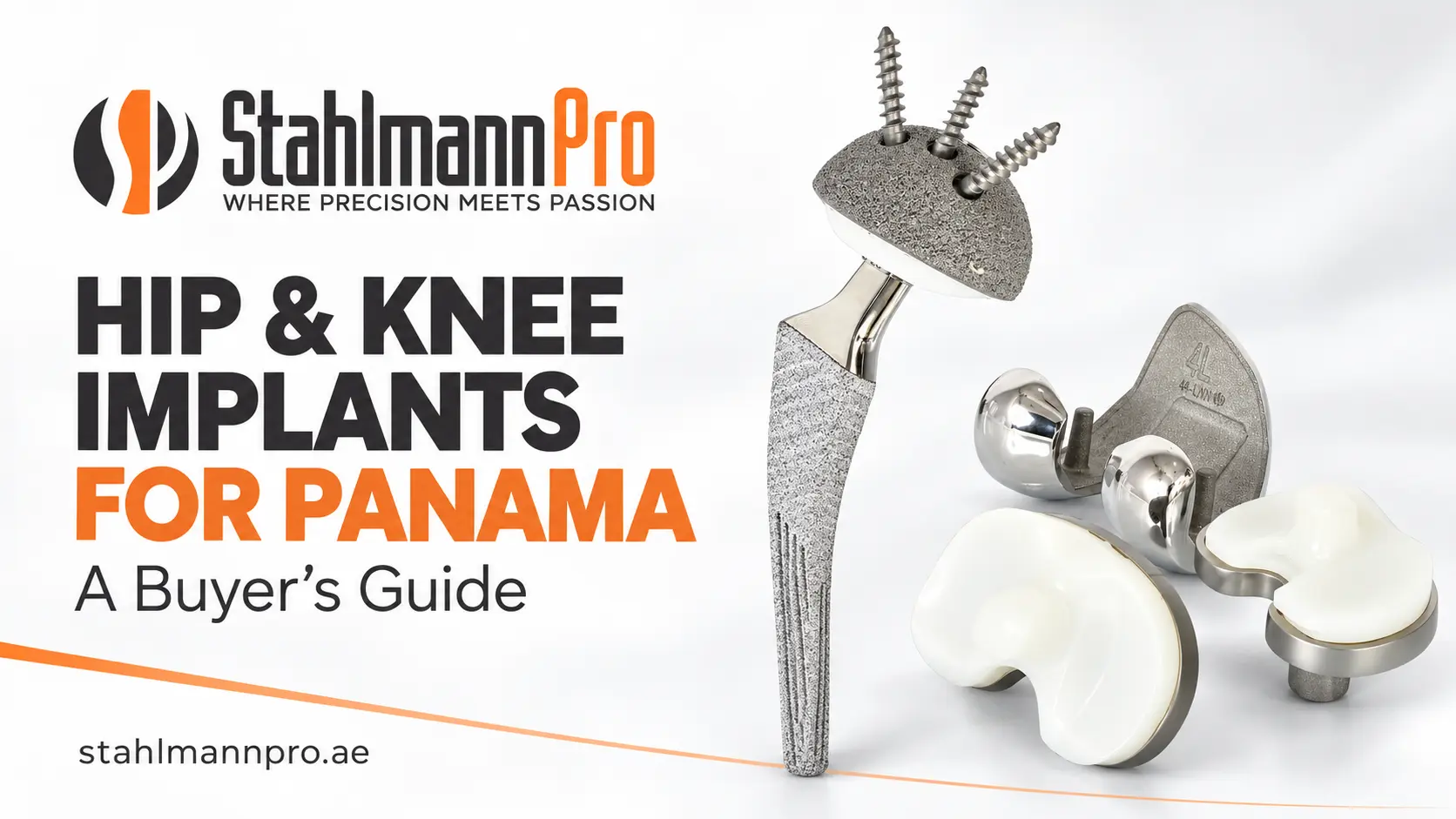
Hip and Knee Implants for Panama: A Buyer’s Guide from Stahlmann Pro
Choosing hip and knee implants for Panama starts with a clear purchasing brief. Before requesting prices, distributors and hospital procurement teams need to identify the product families they want to evaluate, the documentation their institution requires, and the arrangements needed to support supply.
Stahlmann Pro’s published portfolio includes total hip replacement products, total knee replacement components, and hip prostheses. These categories provide a starting point for a product inquiry. The exact models, supporting documents, and supply conditions for a Panama project should be established through a written proposal.
Which Stahlmann Pro Products Can Buyers Explore?
Total Hip Replacement Products
Our total hip category lists cemented and cementless femoral stems, cemented and cementless acetabular cups, femoral heads, polyethylene acetabular products, and acetabular bone screws.
Start by identifying the intended product family. Then request the model references, dimensions, material specifications, and the manufacturer’s documented component relationships. A category listing helps you find products to investigate; the technical documentation defines the particular offering.
Explore the Stahlmann Pro total hip range when preparing your inquiry.
Total Knee Replacement Components
Our total knee category lists femoral condylar components, tibial trays, tibial inserts, and patellar components.
For a purchasing inquiry, identify the requested system and ask for its component list, size matrix, instrumentation details, and current technical documentation. Where a specific configuration is required, name it in the brief and ask for written confirmation of availability.
Review our total knee replacement category to begin defining your requirements.
Other Hip Prostheses
Our hip prosthesis category includes Austin Moore, Thompson, and bipolar options. Keep inquiries for these products separate from total hip replacement requirements so the quotation clearly identifies the intended product family.
View the hip prosthesis range and include the relevant product names in your request.
How Should Buyers Research Hip and Knee Implants for Panama?
Create a comparison sheet with a separate row for every requested model. Record the information received, its source, its date, and any unresolved question.
For example, “catalog received” and “model-specific technical file received” are different findings. Likewise, a discussion about regional supply is different from written confirmation that a particular product can be supplied through the proposed channel.
Use three evidence categories:
| Evidence category | What to record |
|---|---|
| Product identification | Product name, model reference, catalog version, and proposed configuration |
| Project verification | Relevant official records, responsible local party, and institutional requirements |
| Commercial confirmation | Dated quotation, included items, delivery conditions, and named supplier contact |
This approach gives your team an auditable research record. It also makes follow-up questions more precise.
Where Should Panama’s Regulatory Requirements Be Checked?
Panama’s Dirección Nacional de Dispositivos Médicos at MINSA describes responsibilities covering medical-device regulation, establishment licensing, registration, importation, labeling, surveillance, and traceability.
Use the authority’s current resources and guidance to establish the requirements for the exact devices and supply activities involved. The local responsible party should identify the applicable route and any additional requirements of the purchasing institution.
A product appearing on Stahlmann Pro’s website does not establish its authorization or immediate availability in Panama.
What Should a Useful Supplier Inquiry Contain?
Give the supplier enough information to respond to a defined project. A brief inquiry can include:
- Your company or institution and the contact responsible for evaluation.
- The requested hip or knee product families.
- Known model references and the required configurations.
- Estimated opening quantities and the basis for that estimate.
- Required instruments and any existing equipment constraints.
- The documents requested by your institution or local regulatory representative.
- Intended destination and target purchasing schedule.
Ask the supplier to mark each requirement as confirmed, pending clarification, or unavailable. This avoids treating unanswered items as included.
Worked Example: Turning a Catalog Request into a Purchasing Brief
Illustrative example only. The following is not an actual customer project, supplier quotation, or clinical recommendation.
A distributor is considering a small initial knee implant purchase. Its first message says: “Please send your best knee implant price.”
That request leaves the supplier guessing about the intended configuration, component quantities, instruments, and delivery basis.
A more useful message would be:
“Our team is evaluating your total knee product range for a proposed Panama purchasing project. Please identify the system you propose, provide the available component references and size matrix, and quote an opening package against the attached quantity schedule. List instrumentation, documentation, freight, and other charges separately. Please identify any requirement that remains unconfirmed.”
The improved inquiry creates a record that can be checked line by line. If a response omits instrument charges, the buyer can ask a specific follow-up before comparing totals.
How Can Buyers Make Quotation Comparisons More Reliable?
Use a single inquiry template for all suppliers. Keep an assumptions column beside each price so differences remain visible.
For internal comparison, a simple budget structure is:
Proposed purchasing budget = quoted products + separately charged instruments + logistics + applicable import costs + other agreed project charges.
This is a planning template. It does not establish the taxes, fees, or accounting treatment applicable to your transaction.
Record the quotation currency, validity period, delivery basis, and exclusions. When one supplier leaves an item unpriced, mark it as unresolved rather than entering zero. Revisit the comparison when the missing information arrives.
What Evidence Should Support a Final Decision?
Match each important statement to a document. Product specifications should point to the relevant technical file. Commercial promises should appear in the quotation or agreement. Regulatory status should be checked through the appropriate official evidence.
If clinical performance is part of the evaluation, request product-specific published evidence for review by qualified professionals. A catalog description should not be presented as comparative clinical research.
Keep a record of what has been verified and what remains conditional. This makes the purchasing decision easier to review and update.
Request Product Details from Stahlmann Pro
To discuss hip and knee implants for Panama, send Stahlmann Pro your intended product families, estimated quantities, documentation needs, and proposed purchasing schedule.
Begin with the relevant product category, then contact our team for a focused inquiry.
Email: info@stahlmannpro.ae
Telephone: +971 50 975 0822
Frequently Asked Questions
Which hip and knee products does Stahlmann Pro list?
Our website lists total hip replacement products, total knee components, and hip prostheses. Use the linked categories to identify products for a model-specific inquiry.
Does the website confirm that these products are registered in Panama?
No. A website listing is not evidence of Panama authorization. Verify the status of the exact products and the proposed supply route.
Can I request a quotation before finalizing quantities?
You can submit a preliminary inquiry with estimated quantities. Clearly label estimates and ask the supplier to state the assumptions used in the response.
What should I do if a quotation is incomplete?
List the missing information and request a revised quotation. Keep unconfirmed costs and conditions visible in your comparison.
Where can I check Panama medical-device information?
Start with MINSA’s Dirección Nacional de Dispositivos Médicos. Confirm the requirements for your exact project with the responsible authority or qualified local regulatory representative.
