
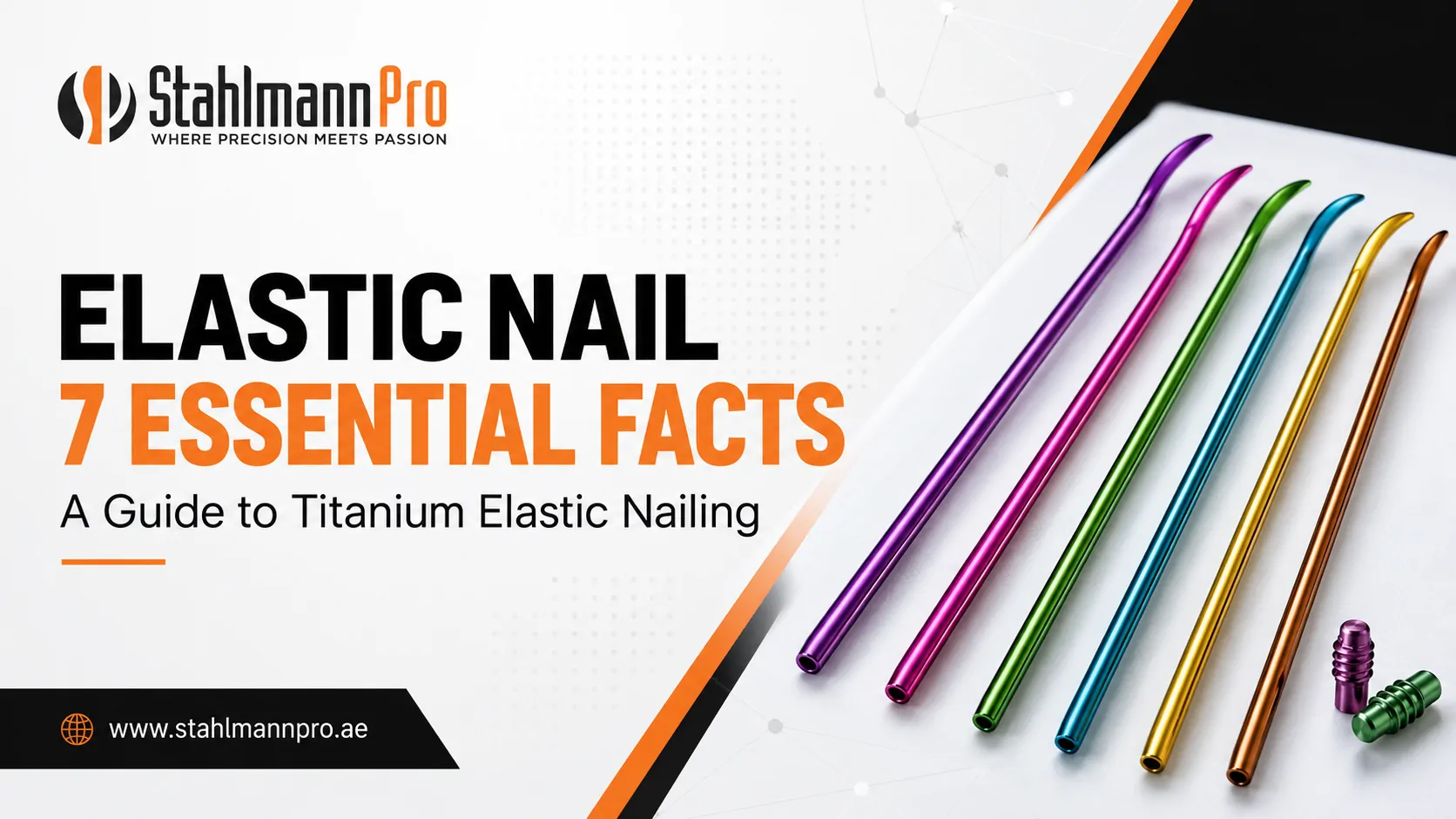
Elastic Nail fixation, commonly discussed as Titanium Elastic Nailing and Elastic Stable Intramedullary Nailing (ESIN), uses flexible intramedullary implants in selected fracture procedures. An elastic nailing system supports fixation within the medullary canal, with applications that depend on the bone, fracture pattern, patient, and implant instructions.
For surgeons, the central question is whether the selected construct can provide appropriate stability. For hospitals and orthopedic distributors, that decision must translate into clear specifications, compatible instruments, and identifiable product configurations.
This guide explains the terminology, important anatomical differences, and purchasing considerations. Visit the Stahlmann Pro Elastic Nail product page for brand-specific product information and enquiries.
1. What Is an Elastic Nail?
An Elastic Nail is a flexible implant positioned inside the medullary canal, the internal cavity of a bone. It is one component of a fixation construct used to stabilize an appropriately selected fracture.
Several related terms appear in clinical references and product catalogues:
| Term | Meaning |
|---|---|
| Elastic Nail | The flexible implant |
| Titanium Elastic Nail | An elastic implant identified as titanium |
| Titanium Elastic Nailing | The technique using titanium elastic implants |
| Elastic Stable Intramedullary Nailing | The fixation technique commonly abbreviated ESIN |
| Elastic nailing system | The implants and compatible components associated with the technique |
| Diaphyseal fracture | A fracture involving the shaft of a long bone |
These terms help readers navigate the subject, but they do not establish that every product has identical dimensions, features, or approved applications.
Stahlmann Pro’s previously supplied specification identifies TC4 titanium alloy. Buyers should confirm the applicable material documentation and exact product configuration before ordering.
2. How Does Elastic Stable Intramedullary Nailing Work?
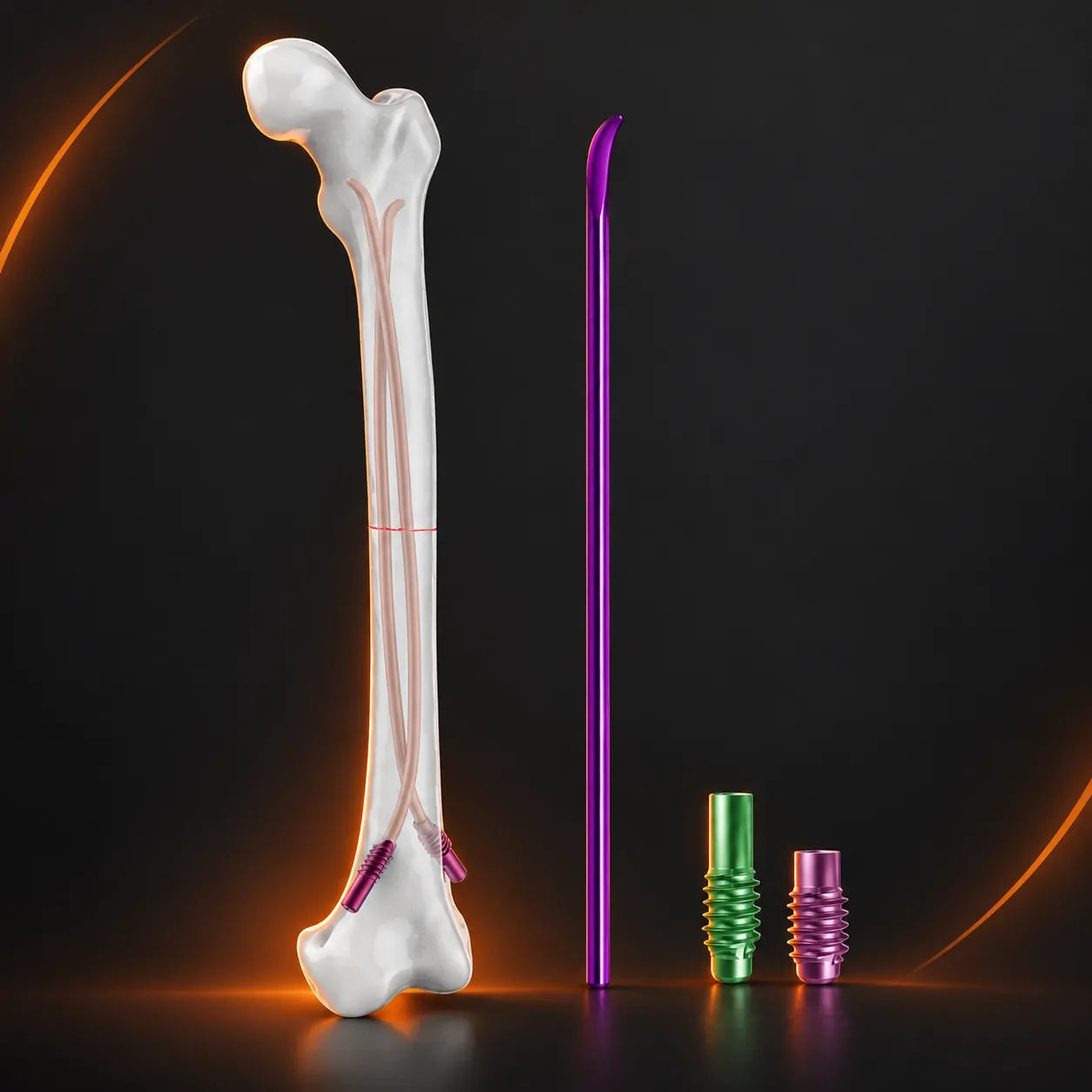
ESIN uses appropriately selected and positioned flexible implants to support fracture alignment. Stability depends on the relationship between implant dimensions, contour, bone anatomy, and fracture geometry.
The flexible design is therefore part of a mechanical concept, rather than a promise that the implant will suit every fracture. A thin nail, a larger nail, and a different configuration will not necessarily provide the same behavior.
AO’s pediatric femoral reference describes paired nails and fracture-specific configuration considerations. This illustrates why implant selection must follow the procedure and anatomical site.
Another important distinction concerns insertion direction. Elastic nails are not universally inserted from opposite ends of the same bone. Their arrangement varies between femoral, tibial, forearm, and humeral techniques.
Explore the Stahlmann Pro Intramedullary Nailing System for related product categories.
3. Which Fractures Are Discussed in Elastic Nailing References?
Elastic nailing appears in references covering several anatomical sites. These general clinical applications must be distinguished from the documented indications of a particular product.
Femoral Shaft Fractures
Selected pediatric femoral shaft fractures may be treated using ESIN. The fracture’s ability to maintain length and alignment is an important consideration.
AO’s femoral guidance discusses additional considerations for multifragmentary patterns. The presence of several fragments means that the fixation problem differs from a simple shaft fracture.
Tibial Shaft Fractures
AO describes three-point contact in pediatric tibial elastic nailing. It also identifies distal shaft and metaphyseal applications as more challenging, with additional immobilization potentially required.
Elastic fixation should therefore not be promoted as always eliminating a cast or other support.
Radius and Ulna Fractures
Forearm ESIN may involve a nail in each affected bone. The radius and ulna have different entry-direction considerations, so this arrangement differs from two nails placed within a single femur.
Forearm fixation also requires attention to nearby tendons and nerves.
Proximal Humerus Fractures
AO describes elastic nailing for selected pediatric proximal humeral metaphyseal fractures. Its illustrated approach uses two nails introduced from the lateral distal humerus in a retrograde direction.
This expands the educational discussion beyond lower-limb fractures. It does not establish that Stahlmann Pro’s specific product is approved for that application.
| Anatomical site | Important distinction |
|---|---|
| Femur | Paired-nail configuration and fracture stability require assessment |
| Tibia | Fracture location may affect stability and additional support |
| Forearm | Fixation involves the individual radius and ulna |
| Proximal humerus | A distinct anatomical approach and configuration are described |
4. Why Does Growth-Plate-Aware Planning Matter?
Growth plates are an important consideration in pediatric fracture treatment. Entry points and final nail positioning must be planned according to the anatomy and clinical technique.
However, “elastic nails never cross a growth plate” is too broad a statement. AO’s proximal humerus guidance describes selected circumstances where nail tips may need to extend beyond the physis to achieve adequate stability.
This is why a reliable explanation must distinguish a general treatment goal from a rule that applies to every anatomical site.
Similarly, limited surgical exposure may be possible, but open reduction can be necessary. The implant does not guarantee a closed procedure, avoidance of tissue injury, or prevention of growth disturbance.
5. What Should Readers Know About Recovery and Removal?
Recovery is specific to the injury and fixation construct. Permission to use the limb or bear weight cannot be determined from the product name alone.
AO’s pediatric tibial reference describes protected weight-bearing followed by progression according to clinical and radiographic findings. Immediate full weight-bearing should not be presented as a universal benefit.
Implant removal is also a clinical decision. Local irritation, healing, and remodeling may influence the assessment. A fixed removal date should not be promised for every patient.
For patients and families, the practical priority is a clear follow-up plan from the treating team. For product buyers, the priority is accurate specifications rather than claims of guaranteed faster healing.
6. What Makes an Elastic Nailing System Easier to Evaluate?
A product page becomes more useful when it helps readers identify the exact implant and supporting information.
A photograph and a material name provide a starting point. A complete purchasing evaluation also needs dimensions, product codes, compatible instruments, supplied condition, and applicable documents.
| Information to request | Purchasing purpose |
|---|---|
| Available diameters and lengths | Identify the required configurations |
| Product codes | Reduce ambiguity in quotations and orders |
| Material documentation | Support the stated material specification |
| Instructions for use | Establish product-specific applications and limitations |
| Sterile or non-sterile condition | Clarify handling and processing requirements |
| Compatible instruments and accessories | Define the required system |
| Order contents | Confirm what is included in the quotation |
| Labeling and traceability | Support hospital purchasing records |
The supplied Stahlmann Pro details state a minimum order quantity of one piece and a delivery timeframe of 5–15 days. Confirm these terms for the requested configuration, quantity, and destination.
Packaging described as a PE inner bag and carton does not establish sterile status. Likewise, a certificate should be checked for its actual coverage of the product.
Review the Elastic Nail product page and use the Stahlmann Pro contact page to request the required information.
7. What Should Distributors in Africa, Latin America, and Russia Confirm?
Distributor enquiries should identify the destination country and the intended customer requirements.
Africa and Latin America include many markets with different import and purchasing arrangements. Russia also requires destination-specific confirmation. A regional marketing statement alone does not demonstrate local authorization.
For an accurate quotation, provide:
- Required implant dimensions and quantities.
- Product codes, where available.
- Instrument and accessory requirements.
- Destination country and delivery address.
- Requested labeling language.
- Hospital or importer documentation requirements.
- Required delivery date.
Retain the confirmed product-code list and quotation for repeat orders. This helps the purchasing team request the same configuration consistently.
For a broader enquiry, explore the Stahlmann Pro Trauma Implants range.
Frequently Asked Questions
Is an Elastic Nail the same as ESIN?
No. The nail is the implant. ESIN describes Elastic Stable Intramedullary Nailing, the fixation technique.
Is Titanium Elastic Nailing only discussed for leg fractures?
No. Clinical references also describe forearm and selected humeral applications. The selected product’s instructions must establish its actual indications.
Are two nails always inserted from opposite ends?
No. Entry direction and configuration depend on the bone and technique. A single description should not be applied to every anatomical site.
Does elastic nailing always avoid the growth plate?
No universal claim should be made. Growth-plate-aware planning is important, but some bone-specific techniques describe exceptions.
Can patients bear weight immediately?
Weight-bearing follows the treating surgeon’s assessment and instructions. The implant name does not establish a recovery timetable.
What should a hospital include in a quotation request?
Provide required sizes, quantities, product codes, instrument needs, destination, and documentation requirements.
Clinical References
For bone-specific educational background, consult:
- AO: Pediatric femoral shaft ESIN.
- AO: Pediatric tibial elastic nailing.
- AO: Forearm ESIN.
- AO: Proximal humerus elastic nailing.
These references describe clinical techniques. They do not establish Stahlmann Pro product approval or represent an endorsement of the brand.
Request Stahlmann Pro Elastic Nail Information
For configurations and purchasing enquiries in Africa, Latin America, or Russia, visit the Stahlmann Pro Elastic Nail page or contact the team.
Email: info@stahlmannpro.ae
Phone / WhatsApp: +971 50 975 0822
Enquiries: Contact Stahlmann Pro
