
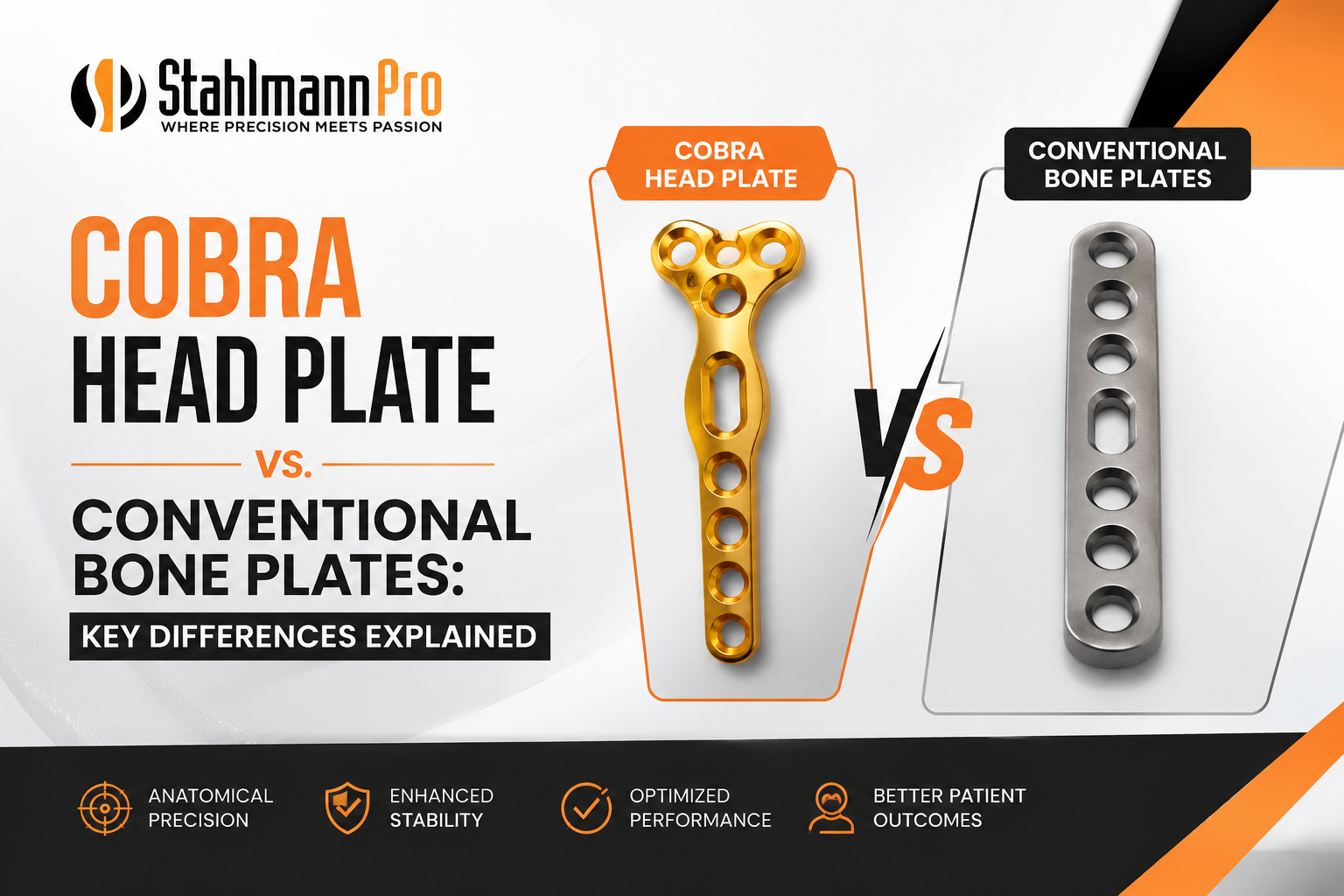
Bone fractures and orthopedic injuries require precise fixation methods to ensure proper healing and restore mobility. Among the many fixation devices used by orthopedic surgeons, Cobra Head Plates and Conventional Bone Plates are two commonly discussed options. While both are designed to stabilize fractured bones, they differ significantly in design, application, biomechanics, and clinical advantages.
Understanding these differences is essential for orthopedic professionals, healthcare institutions, and medical device buyers looking to select the most suitable implant for specific surgical procedures.
In this guide, we’ll explain the key differences between Cobra Head Plates and Conventional Bone Plates, their advantages, applications, and factors to consider when choosing the right orthopedic implant.
What Is a Cobra Head Plate?
A Cobra Head Plate is a specialized orthopedic fixation plate designed primarily for fractures involving small bones, periarticular regions, and complex anatomical structures. Its distinctive cobra-shaped head provides multiple screw placement options, allowing surgeons to achieve secure fixation while preserving bone integrity.
The design offers enhanced stability in areas where traditional straight plates may not provide sufficient fixation.
Common Uses of Cobra Head Plates
- Distal femur fractures
- Proximal tibia fractures
- Complex periarticular fractures
- Osteotomy procedures
- Small fragment fixation
- Trauma reconstruction surgeries
What Are Conventional Bone Plates?
Conventional Bone Plates are standard orthopedic fixation devices available in various sizes and configurations. They are designed to stabilize fractured bones by holding bone fragments together while natural healing occurs.
These plates have been widely used for decades and remain a trusted solution for many simple and moderately complex fractures.
Common Types of Conventional Bone Plates
- Dynamic Compression Plates (DCP)
- Limited Contact Dynamic Compression Plates (LC-DCP)
- Reconstruction Plates
- Tubular Plates
- Locking Compression Plates (LCP)
Each type serves different orthopedic applications depending on fracture location and complexity
Cobra Head Plate vs. Conventional Bone Plates: Side-by-Side Comparison
| Feature | Cobra Head Plate | Conventional Bone Plate |
|---|---|---|
| Design | Wide cobra-shaped head | Straight or contoured design |
| Screw Placement | Multiple angled screw options | Standard linear screw arrangement |
| Stability | Excellent for complex fractures | Suitable for standard fractures |
| Anatomical Fit | Designed for specific anatomy | General-purpose design |
| Surgical Flexibility | High | Moderate |
| Fracture Complexity | Complex and periarticular fractures | Simple to moderately complex fractures |
| Bone Preservation | Better distribution of forces | Standard force distribution |
| Clinical Use | Trauma and reconstructive surgery | General orthopedic fixation |
Design Differences
The most noticeable distinction lies in their structural design.
Cobra Head Plate
The expanded head resembles the shape of a cobra, allowing:
- Multiple screw trajectories
- Better fixation around joints
- Improved stability in small bone fragments
- Enhanced resistance to rotational forces
This design is especially valuable when fractures occur close to joints where bone fragments are irregular.
Conventional Bone Plates
Traditional plates feature a straight profile with evenly spaced screw holes.
Their advantages include:
- Simpler surgical technique
- Versatility across multiple fracture types
- Broad availability
- Cost-effective treatment
However, they may offer fewer fixation options in highly complex fractures.
Biomechanical Performance
Biomechanical stability plays a major role in successful fracture healing.
Cobra Head Plates
The unique head design distributes mechanical loads across multiple screws, reducing stress concentration on individual fixation points.
Benefits include:
- Increased rotational stability
- Better fixation in osteoporotic bone
- Reduced implant loosening
- Improved support for complex fracture patterns
Conventional Bone Plates
Traditional plates provide excellent compression and stabilization for standard fractures.
However, when dealing with fragmented or periarticular fractures, additional implants or fixation methods may be required.
Surgical Applications
When Cobra Head Plates Are Preferred
Orthopedic surgeons often choose Cobra Head Plates for:
- Multi-fragment fractures
- Joint-adjacent fractures
- Osteoporotic bone
- Revision surgeries
- Complex trauma cases
The additional screw placement flexibility allows surgeons to tailor fixation according to fracture anatomy.
When Conventional Bone Plates Are Preferred
Conventional plates remain ideal for:
- Simple shaft fractures
- Mid-bone fractures
- Standard trauma procedures
- Elective orthopedic surgeries
- Routine fracture fixation
Their straightforward design often results in shorter surgical times.
Advantages of Cobra Head Plates
Enhanced Fixation
Multiple screw orientations provide stronger fixation for unstable fractures.
Improved Anatomical Contouring
The plate adapts better to irregular bone surfaces.
Better Load Distribution
Mechanical stress spreads across several fixation points, reducing implant failure risk.
Greater Stability
Excellent resistance against rotational and bending forces.
Ideal for Complex Cases
Highly effective for fractures involving joints and small bone fragments.
Advantages of Conventional Bone Plates
Proven Clinical Success
Backed by decades of orthopedic experience.
Cost-Effective
Generally more economical than specialized implants.
Widely Available
Available in nearly every orthopedic implant system.
Easier Surgical Technique
Surgeons are highly familiar with their implantation procedures.
Versatility
Suitable for numerous fracture types across different bones.
Material Comparison
Both implant types are commonly manufactured using:
- Medical-grade Stainless Steel
- Titanium Alloy
- Titanium with locking technology
Titanium implants are often preferred because they offer:
- Excellent biocompatibility
- Corrosion resistance
- Lightweight construction
- Reduced interference with imaging
- Lower risk of allergic reactions
Choosing the Right Plate
Selecting between a Cobra Head Plate and a Conventional Bone Plate depends on several clinical factors.
Surgeons typically evaluate:
- Fracture pattern
- Bone quality
- Patient age
- Location of injury
- Degree of fragmentation
- Desired postoperative stability
- Surgical objectives
No single implant is universally superior. The best choice depends on the specific clinical scenario and the surgeon’s expertise.
Recovery and Healing
Regardless of implant selection, successful recovery depends on:
- Accurate fracture reduction
- Stable fixation
- Patient compliance
- Rehabilitation
- Nutrition
- Infection prevention
A properly selected implant contributes significantly to faster healing and improved long-term outcomes.
Future Trends in Orthopedic Plate Technology
Orthopedic implant technology continues to evolve with innovations such as:
- Patient-specific implants
- 3D-printed orthopedic plates
- Advanced locking plate systems
- Bioactive implant coatings
- Improved titanium alloys
- Minimally invasive fixation techniques
These advancements aim to improve healing rates while minimizing surgical complications.
Conclusion
Both Cobra Head Plates and Conventional Bone Plates play critical roles in modern orthopedic surgery. While conventional plates remain the standard solution for many fractures, Cobra Head Plates provide distinct advantages in complex, periarticular, and anatomically challenging cases.
Choosing the appropriate implant depends on fracture complexity, bone quality, anatomical location, and surgical goals. By understanding the strengths of each fixation system, orthopedic professionals can make informed decisions that improve patient outcomes and long-term stability.
As orthopedic technology continues to advance, specialized implants like Cobra Head Plates are expected to play an increasingly important role in treating complex fractures with greater precision and reliability.
Frequently Asked Questions (FAQs)
What is a Cobra Head Plate used for?
A Cobra Head Plate is primarily used for stabilizing complex fractures near joints, periarticular fractures, osteotomies, and small bone fragment fixation.
How is a Cobra Head Plate different from a conventional bone plate?
The main difference is its widened cobra-shaped head, which allows multiple screw angles and improved fixation for complex fracture patterns compared to the straight design of conventional bone plates.
Are Cobra Head Plates suitable for osteoporotic bone?
Yes. Their multi-directional screw configuration provides enhanced fixation and stability in patients with reduced bone density.
Which material is better for orthopedic bone plates?
Titanium is generally preferred because it is lightweight, highly biocompatible, corrosion-resistant, and compatible with modern medical imaging. Stainless steel remains a reliable and cost-effective alternative for many procedures.
Can conventional bone plates treat complex fractures?
They can be used in some complex cases, but specialized implants like Cobra Head Plates often provide better fixation and stability for fractures involving joints or multiple bone fragments.
How long do orthopedic bone plates remain in the body?
Many bone plates remain permanently unless they cause discomfort, infection, or require removal due to specific medical reasons. Implant removal should always be determined by an orthopedic surgeon.
What factors determine the choice between Cobra Head Plates and conventional bone plates?
Surgeons consider fracture type, bone quality, patient age, anatomical location, level of fragmentation, and the desired stability before selecting the most appropriate implant.
