
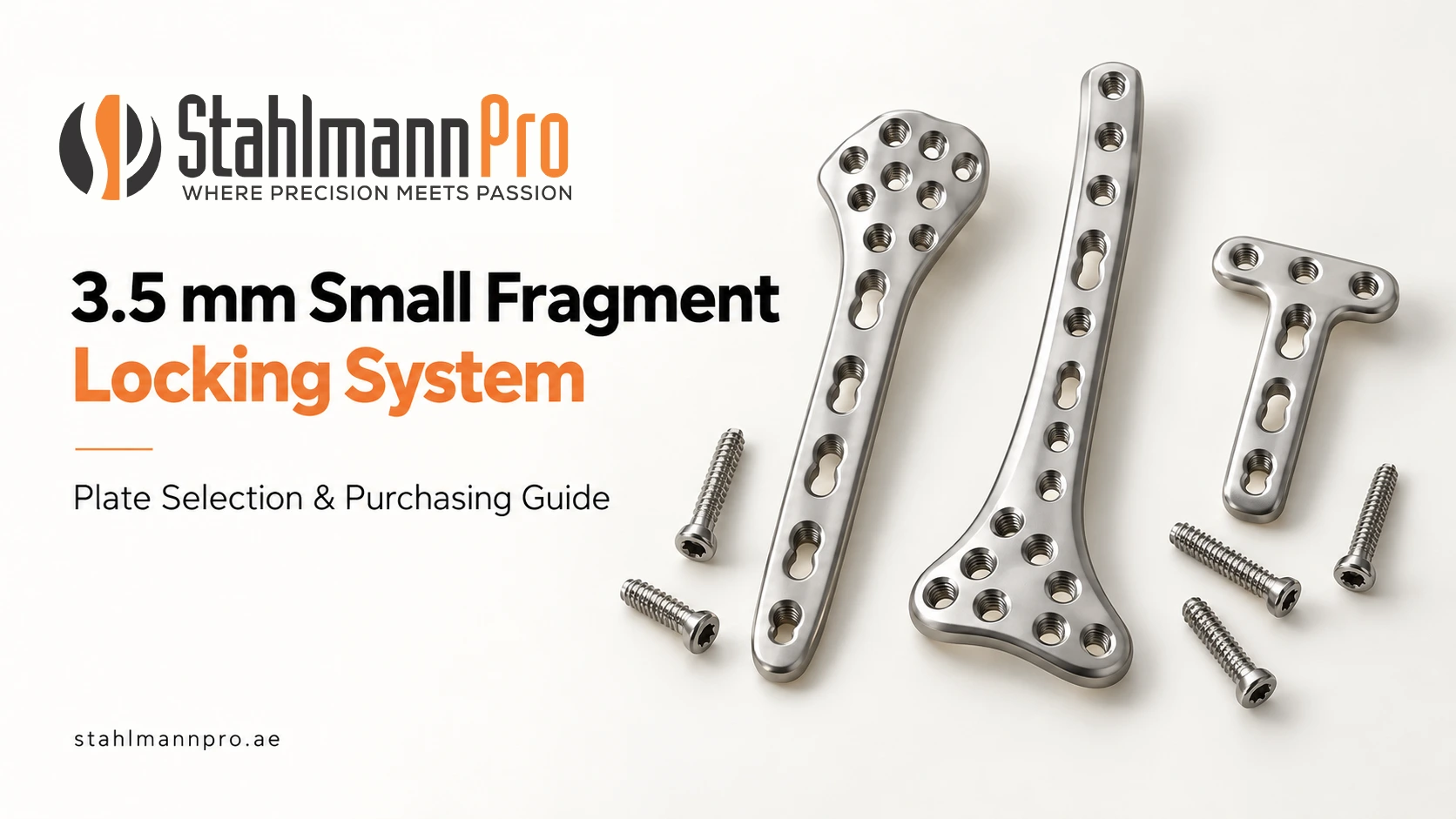
3.5 mm Small Fragment Locking System: Selection and Buying Guide
A 3.5 mm Small Fragment Locking System brings together orthopedic plates, compatible screws, and supporting instruments for selected fracture fixation applications. Understanding the plate design, screw interface, and available configurations helps clinical and purchasing teams evaluate the system more accurately.
For a surgeon, the starting point is the injury and planned fixation strategy. For a hospital buyer, it is a complete specification that identifies the requested implants and instruments. For a distributor, it is a clear product reference that can be used consistently across quotations and repeat orders.
Explore the Stahlmann Pro 3.5 mm Small Fragment Locking System to review the current listings.
What Is a 3.5 mm Small Fragment Locking System?
A small fragment locking system is a plate-and-screw fixation system in which compatible locking screw heads engage with the plate’s locking interface.
The 3.5 mm designation identifies the system family. It does not mean every plate is 3.5 mm thick or that every hole accepts the same screw. Individual designs can have different component requirements, including combined diameter designations.
The selected product’s specifications establish which plates, screws, and instruments belong together.
How Do Locking Plates Differ from Conventional Plates?
The main distinction is the connection between the screw head and plate.
In conventional fixation, tightening a conventional screw draws the plate toward the bone. In a locking construct, the locking screw head engages with the plate, creating an angularly stable connection.
| Feature | Conventional fixation | Locking fixation |
|---|---|---|
| Screw-to-plate interface | Conventional screw head seated in a plate hole | Compatible locking head engaged with the plate |
| Mechanical principle | Includes compression of the plate against bone | Uses the locked plate-and-screw relationship |
| Component selection | Requires the correct conventional screw and hole | Requires the correct locking interface and screw |
| Clinical choice | Depends on the intended fixation strategy | Depends on the intended fixation strategy |
Locking fixation does not make reduction, plate positioning, or screw selection less important. It is a different fixation concept rather than a universal replacement for conventional plating.
For educational background, see the AO Surgery Reference explanation of plating principles.
Plate Designs in the Stahlmann Pro Category
The current category contains several anatomical and shaped plate designs. Examples include:
- Proximal humerus locking plates.
- Distal humerus plates with 2.7/3.5 mm designations.
- Small locking T-plates.
- Medial distal tibia plates with and without a tab.
- Anterolateral distal tibia plates.
- Proximal tibia locking plates.
These names help buyers navigate the range. They do not establish suitability for every fracture in the named anatomical region.
Humerus Plate Configurations
When evaluating a proximal or distal humerus plate, identify the exact design, dimensions, side designation where applicable, and corresponding screw requirements.
A short and long version should be treated as separate ordering configurations. Likewise, a plate with lateral support should not be substituted solely because another product has a similar name.
Tibia Plate Configurations
Medial distal tibia, anterolateral distal tibia, and proximal tibia plates represent different configurations.
A quotation should identify the requested plate by product code and design. “Tibia locking plate” alone may leave uncertainty about the location, side, length, and associated components.
Small T-Plates
For T-shaped plates, confirm the head configuration, shaft dimensions, hole count, and compatible screws.
The shape provides a useful visual reference, but an image should be supported by a catalogue specification before an order is finalized.
Locking Screws and Instrument Compatibility
A plate order is incomplete unless the required screws and supporting instruments are identified.
The broader Stahlmann Pro Small Fragment range lists locking screw options alongside its plate families. Confirm the exact screw reference for the selected plate.
Relevant questions include:
- Which screw diameters and lengths are supported?
- Does the plate accept locking screws, conventional screws, or both in designated holes?
- Which driver interface is required?
- Which drill guides and drill bits belong to the system?
- Is a specified torque-limiting instrument required?
- Are implants and instruments supplied separately?
Matching nominal diameters do not establish cross-system compatibility. The screw head interface, plate design, and instrument requirements must also match.
The AO reference on locking head screws provides general educational context. Product-specific instructions remain essential.
What Should Hospitals Confirm Before Buying?
A useful purchasing request should be detailed enough to produce an identifiable quotation.
| Information to confirm | Why it matters |
|---|---|
| Plate name and product code | Identifies the requested implant |
| Anatomical configuration and side | Distinguishes related designs |
| Plate length and hole count | Defines the required version |
| Screw references, lengths, and quantities | Completes the implant requirement |
| Instrument compatibility | Identifies the supporting equipment |
| Material specification | Confirms the selected product’s material |
| Sterile or non-sterile condition | Clarifies handling and processing |
| Instructions for use | Establishes intended applications and limitations |
| Labeling and traceability | Supports hospital purchasing records |
| Applicable documentation | Identifies evidence relevant to the product |
| Quotation contents and delivery terms | Clarifies what will be supplied |
For example, instead of requesting “ten 3.5 mm locking plates,” provide the exact plate reference, required configurations, associated screws, and delivery destination.
What Determines the Price of a Small Fragment Locking System?
A locking plate quotation can vary according to the selected design, dimensions, material, quantities, and associated components.
A plate-only price cannot be compared directly with a quotation that includes screws and instruments. Hospitals comparing orthopedic locking plate prices should first align the contents of each offer.
Request an itemized quotation showing:
- Plate references and quantities.
- Screw references and quantities.
- Instrument set contents.
- Packaging and supplied condition.
- Delivery arrangements.
- Applicable commercial terms.
For a broader purchasing enquiry, review the Stahlmann Pro Trauma Implants range.
Enquiries for Africa, Latin America, and Russia
Stahlmann Pro welcomes small fragment locking system enquiries from hospitals and medical distributors in Africa, Latin America, and Russia.
Include the destination country, requested products, quantities, documentation needs, and labeling requirements. These details help the team prepare a quotation relevant to the order.
Distributors planning repeat purchases should retain the confirmed product-code list. This makes subsequent enquiries clearer and helps avoid unintended substitutions.
Use the Stahlmann Pro contact page to discuss product information, availability, and order requirements.
Frequently Asked Questions
What does “3.5 mm” mean in a small fragment locking system?
It identifies the system family associated with its component sizing. It does not establish plate thickness or universal screw compatibility.
Are locking plates better for every fracture?
No single fixation concept is appropriate for every fracture. Implant selection depends on the injury, anatomy, fixation strategy, and product-specific instructions.
Can conventional screws be used in a locking plate?
Some designs accommodate conventional screws in designated holes. Confirm this capability for the selected plate rather than assuming it applies across the range.
Are all screws in the system interchangeable?
No. Diameter alone is insufficient. The plate interface, screw design, and documented compatibility must match.
Are plates supplied with screws and instruments?
Check the quotation. Plates, screws, and instrument sets may be supplied or priced separately.
How can I request a small fragment locking plate price?
Provide the plate code, dimensions, quantities, screw requirements, instrument needs, and destination. An itemized request supports a more accurate quotation.
Does a locking plate guarantee faster healing?
No. An implant design does not establish a guaranteed healing time or rehabilitation schedule. Follow-up and activity decisions belong to the treating clinical team.
Request a 3.5 mm Small Fragment Locking System Quotation
Browse the 3.5 mm Small Fragment Locking System category and send your selected product references to Stahlmann Pro.
For associated products, explore the Small Fragment range or the wider Trauma Implants portfolio.
Email: info@stahlmannpro.ae
Phone / WhatsApp: +971 50 975 0822
Enquiries: Contact Stahlmann Pro
