
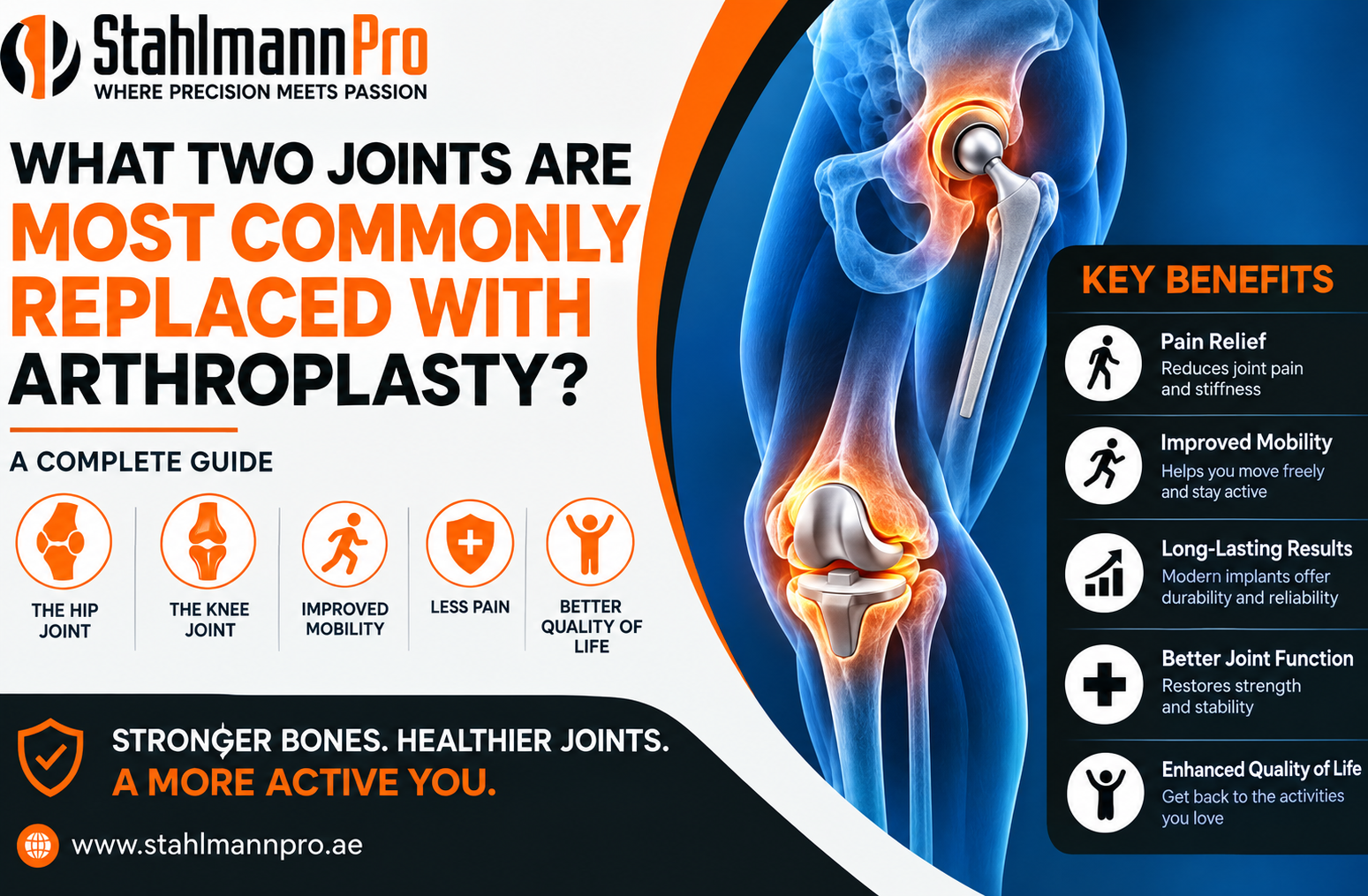
Arthroplasty is a surgical procedure used to repair or replace a damaged joint. It is commonly considered when severe joint damage causes persistent pain, stiffness, reduced mobility, or difficulty performing everyday activities. Depending on the condition, a surgeon may replace part or all of the joint with an artificial implant.
Among the different joints that can undergo arthroplasty, the hip and knee are the two most commonly replaced joints. Both joints carry significant loads during daily activities and can become damaged by osteoarthritis, rheumatoid arthritis, injuries, and other conditions.
What Is Arthroplasty?
Arthroplasty is a type of orthopedic surgery designed to restore joint function. In a joint replacement procedure, damaged bone and cartilage may be removed and replaced with artificial components designed to allow smoother movement.
The exact procedure depends on the joint being treated and the patient’s condition. Some procedures replace the entire joint, while others replace only a damaged portion.
The main goals of arthroplasty are to reduce pain, improve movement, restore function, and help patients return to normal daily activities.
1. Hip Arthroplasty
Hip replacement is one of the most frequently performed joint replacement procedures. The hip is a ball-and-socket joint that connects the thigh bone to the pelvis. Its structure allows movements such as walking, sitting, climbing stairs, and rotating the leg.
During total hip arthroplasty, the damaged femoral head and part of the femur are replaced with an artificial component. The damaged surface of the hip socket may also be replaced with an artificial cup.
Why Is Hip Replacement Needed?
Hip arthroplasty may be recommended when the joint has significant damage that does not respond adequately to conservative treatment. Common causes include osteoarthritis, rheumatoid arthritis, hip fractures, avascular necrosis, and certain traumatic injuries.
Patients with advanced hip joint damage may experience pain in the hip, groin, thigh, or buttocks. Stiffness can also make walking, putting on shoes, getting into a car, or climbing stairs difficult.
Types of Hip Arthroplasty
Total hip replacement is the most familiar form of hip arthroplasty. However, other procedures may be appropriate depending on the patient’s condition.
Total hip arthroplasty replaces both major sides of the joint.
Partial hip replacement generally replaces the femoral head while leaving the socket intact. It is often considered for particular types of hip fractures.
The choice depends on factors such as the extent of joint damage, bone quality, age, activity level, and overall health.
2. Knee Arthroplasty
Knee replacement is another extremely common arthroplasty procedure. The knee is a complex joint formed primarily by the femur, tibia, and patella. It absorbs substantial forces during walking, standing, running, and other activities.
In total knee arthroplasty, damaged portions of the knee are removed and replaced with artificial components. The procedure is intended to create a functional joint surface that can move with less pain.
Why Is Knee Replacement Needed?
Severe osteoarthritis is one of the leading reasons people undergo knee replacement. Other causes may include rheumatoid arthritis, post-traumatic arthritis, joint deformity, and significant cartilage damage.
Symptoms that may lead to consideration of knee arthroplasty include persistent pain, swelling, stiffness, reduced range of motion, and difficulty walking or completing normal activities.
When non-surgical treatments no longer provide sufficient relief, an orthopedic surgeon may evaluate whether knee replacement is appropriate.
Types of Knee Arthroplasty
Knee replacement does not always involve replacing every part of the knee.
Total knee arthroplasty replaces the damaged surfaces of the knee joint.
Partial knee replacement may be considered when arthritis is limited to a specific compartment of the knee and the remaining structures are healthy enough to function properly.
The appropriate approach depends on the location and severity of the damage.
Why Are the Hip and Knee So Commonly Replaced?
The hip and knee are both major weight-bearing joints. They experience repeated mechanical stress throughout a person’s life. Activities such as walking, standing, climbing stairs, and lifting place forces through these joints.
Over time, cartilage can deteriorate. Once cartilage becomes severely damaged, bone surfaces may begin to rub against each other, resulting in pain, inflammation, stiffness, and reduced mobility.
Because the hip and knee are essential for movement and are frequently affected by degenerative joint disease, they account for a large proportion of joint replacement procedures.
Arthroplasty Implants and Components
Modern arthroplasty depends on carefully designed implants and surgical instruments. Hip and knee replacement systems can include several components that work together to recreate joint movement.
Hip replacement systems may include femoral stems, femoral heads, acetabular cups, and bearing surfaces. Knee systems can include femoral components, tibial components, and a patellar component depending on the surgical technique and implant design.
Materials used in joint replacement systems are selected for their mechanical properties, durability, and compatibility with the body. Implant design continues to evolve as orthopedic research advances.
What Happens During Arthroplasty?
The exact surgical process varies according to the joint and the patient’s condition. Generally, the surgeon accesses the damaged joint, removes the affected bone and cartilage, prepares the surfaces, and positions the replacement components.
The surgeon carefully checks the alignment, stability, and movement of the joint before completing the procedure.
After surgery, rehabilitation is an important part of recovery. Physical therapy may help restore strength, flexibility, balance, and functional movement.
Recovery After Joint Replacement
Recovery varies from person to person and depends on factors such as the type of surgery, overall health, muscle strength, and rehabilitation progress.
Patients are generally encouraged to follow their orthopedic team’s instructions regarding movement, wound care, physical therapy, and activity levels.
The goal of rehabilitation is to gradually restore mobility while allowing the surgical area to heal appropriately.
Conclusion
The hip and knee are the two joints most commonly replaced with arthroplasty. Both joints play a critical role in mobility and are exposed to considerable mechanical stress throughout life. Conditions such as osteoarthritis, inflammatory arthritis, fractures, and other forms of joint damage can eventually make replacement necessary.
Advances in implant design, surgical techniques, and rehabilitation have continued to improve the options available for patients with severe joint disease. The decision to undergo arthroplasty should always be made with an orthopedic specialist after considering symptoms, imaging results, treatment history, and overall health.
Frequently Asked Questions
What two joints are most commonly replaced with arthroplasty?
The hip and knee are the two joints most commonly replaced with arthroplasty. Both are major weight-bearing joints and are frequently affected by degenerative conditions such as osteoarthritis.
What is the difference between arthroplasty and joint replacement?
Joint replacement is a type of arthroplasty. Arthroplasty is a broader term for surgery that repairs, reshapes, or replaces a joint. When an entire joint is replaced with artificial components, it is commonly called joint replacement.
Is hip or knee replacement more common?
Both hip and knee replacements are among the most commonly performed joint replacement procedures. Their frequency varies by country, population, age group, and healthcare system.
Can arthroplasty replace only part of a joint?
Yes. Some procedures replace only the damaged portion of a joint. Partial hip and partial knee replacements are examples of procedures that preserve some of the patient’s original joint structures.
How long does recovery from arthroplasty take?
Recovery time varies depending on the joint, surgical technique, patient health, and rehabilitation. A healthcare professional can provide a more individualized recovery timeline after evaluating the patient.
