
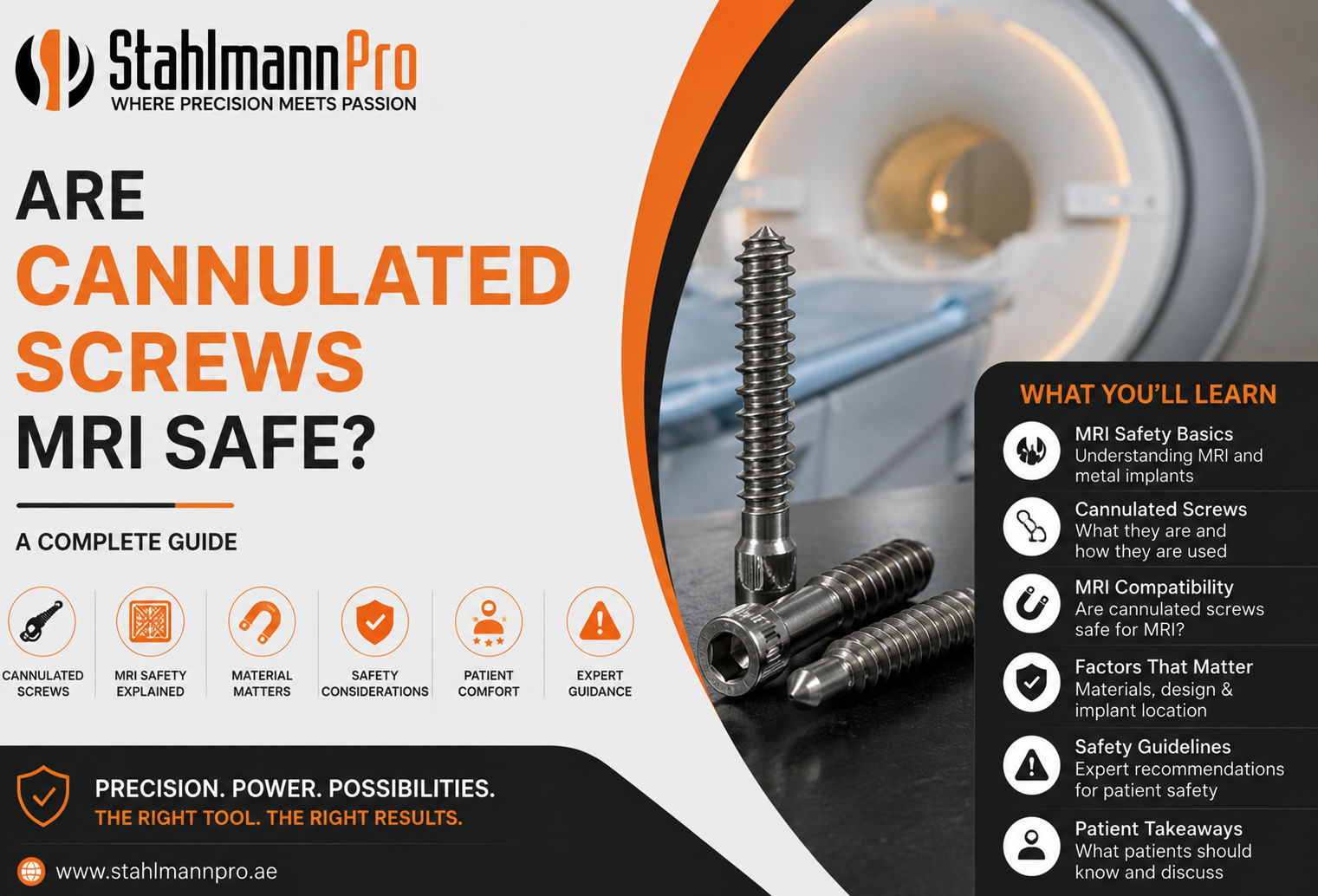
Magnetic resonance imaging, commonly known as MRI, is an important diagnostic imaging method used to examine bones, joints, muscles, ligaments, and other soft tissues. Patients who have undergone orthopedic surgery may naturally wonder whether their implanted hardware is safe during an MRI scan. One common question is: Are cannulated screws MRI safe?
In most cases, orthopedic cannulated screws made from appropriate medical grade materials can be compatible with MRI under specified conditions. However, MRI safety depends on the exact screw material, design, manufacturer specifications, and the conditions of the MRI examination. Patients should always provide information about their implants before undergoing an MRI.
What Are Cannulated Screws?
Cannulated screws are orthopedic fixation devices designed with a hollow channel through the center of the screw. This internal channel allows surgeons to place the screw over a guide wire during certain surgical procedures.
The design can help improve positioning and accuracy during fracture fixation and other orthopedic applications. Cannulated screws are commonly used in procedures involving areas such as the hip, ankle, foot, wrist, and other bones where precise fixation is required.
Depending on the application, these screws can be manufactured from materials such as titanium alloys or stainless steel. The material plays an important role in determining how an implant interacts with an MRI magnetic field.
Why Does MRI Safety Matter?
MRI scanners use a powerful magnetic field along with radiofrequency energy to create detailed images. Metallic implants can potentially interact with this environment in several ways.
The primary concerns include:
- Magnetic attraction or movement
- Heating caused by radiofrequency energy
- Image distortion or artifacts
- Interference with the quality of diagnostic images
Modern orthopedic implants are generally designed with materials and characteristics that allow them to be used safely in appropriate MRI environments. However, this does not mean that every metallic implant is automatically safe under every MRI condition.
Are Cannulated Screws Generally MRI Safe?
Many modern cannulated screws are manufactured using nonferromagnetic or weakly magnetic materials, such as certain titanium alloys. These materials generally have limited interaction with the magnetic field compared with strongly ferromagnetic metals.
However, the term “MRI safe” should not automatically be applied to every cannulated screw.
Medical implants are typically classified according to their MRI labeling, such as:
- MR Safe: The device poses no known hazards in an MRI environment under the defined conditions.
- MR Conditional: The device can be safely used under specific MRI conditions.
- MR Unsafe: The device should not be placed in an MRI environment.
Many orthopedic implants fall into the MR Conditional category. This means the implant may be suitable for MRI when specific requirements, such as magnetic field strength or scanning conditions, are followed.
What Materials Are Used in Cannulated Screws?
The material used to manufacture a cannulated screw can influence its MRI characteristics.
Titanium Alloys
Titanium and titanium alloys are widely used in orthopedic implants because they combine strength, durability, and biocompatibility. They are also generally considered favorable for MRI environments because titanium is nonferromagnetic.
Even with titanium implants, however, the manufacturer’s MRI conditions should be checked.
Stainless Steel
Some orthopedic cannulated screws are produced using surgical stainless steel. Different stainless steel compositions have different magnetic properties, so MRI compatibility cannot be determined simply by knowing that a screw is made from stainless steel.
The exact alloy and manufacturer specifications are important.
Can Cannulated Screws Move During an MRI?
One concern patients may have is whether the MRI’s magnetic field can pull an implanted screw out of position.
For a properly implanted orthopedic screw, significant movement is generally not expected when the implant has been appropriately evaluated for MRI use. The surrounding bone and tissue also provide mechanical stabilization.
Nevertheless, the MRI safety status of the specific implant should always be established before scanning. This is particularly important for recently implanted devices or when the implant documentation is unavailable.
Can Cannulated Screws Heat Up During an MRI?
MRI examinations can produce radiofrequency energy that may cause certain conductive materials to heat.
For orthopedic screws, the risk depends on factors such as:
- Implant material
- Implant size and geometry
- MRI field strength
- Specific absorption rate, or SAR
- Duration of the scan
- MRI system configuration
Manufacturers may provide specific scanning conditions that must be followed to keep the implant within acceptable temperature limits.
This is why healthcare professionals should not rely solely on the general statement that a metal implant is “MRI safe.”
Do Cannulated Screws Affect MRI Images?
Metal implants can produce artifacts on MRI images. These artifacts may appear as distortion, signal loss, or areas of reduced image quality around the implant.
The amount of artifact depends on several factors, including:
- Type of metal
- Implant shape and size
- MRI sequence
- Magnetic field strength
- Position of the implant
- Imaging area
If a patient has a cannulated screw near the area being examined, the radiologist may select particular MRI sequences or imaging techniques to reduce the impact of metal-related artifacts.
What Should Patients Do Before an MRI?
Patients should always tell the MRI technologist, radiologist, or healthcare provider about any orthopedic implants they have.
If possible, provide:
- The implant name or model
- Manufacturer information
- Implant identification card
- Surgical records
- Previous imaging or medical documentation
If the implant information is unavailable, the healthcare team may need to investigate the device before proceeding with the MRI.
Patients should never assume that an implant is safe simply because it is small or because it has been implanted for a long time.
Does the Age of the Implant Matter?
The age of an orthopedic implant can be relevant because older devices may have different materials, designs, or MRI labeling compared with newer products.
If you received cannulated screws many years ago and do not know their exact specifications, inform the MRI facility before your examination. The medical team can determine what information is required to assess MRI compatibility.
Are All Cannulated Screws the Same?
No. Cannulated screws can differ in:
- Material
- Diameter
- Length
- Thread configuration
- Head design
- Manufacturing process
- Intended orthopedic application
- MRI labeling
Therefore, MRI compatibility should be assessed for the specific implant rather than for cannulated screws as a general category.
What Does MR Conditional Mean?
The term MR Conditional is particularly important in orthopedic implant safety.
An MR Conditional implant may be safely scanned when specified conditions are met. These conditions can include the MRI field strength, maximum spatial gradient, SAR limits, scanning time, or other technical parameters.
For this reason, healthcare professionals should consult the manufacturer’s instructions or official MRI safety documentation when available.
Final Thoughts
So, are cannulated screws MRI safe? In many cases, modern cannulated screws can be used in MRI environments under appropriate conditions. Titanium and certain other orthopedic implant materials are commonly compatible with MRI, but compatibility depends on the specific implant and its manufacturer’s labeling.
The safest approach is to identify the exact implant and verify its MRI status before an examination. Patients should always disclose their orthopedic implants to the MRI team and provide implant documentation whenever possible.
MRI safety should never be determined based solely on the appearance, size, or general material category of an implant. The specific manufacturer’s MRI conditions and the patient’s clinical circumstances should guide the final decision.
FAQs
Are cannulated screws MRI safe?
Many modern cannulated screws are MRI compatible under specific conditions. However, MRI safety depends on the screw’s material, design, and manufacturer specifications.
Can I have an MRI with cannulated screws?
In many cases, yes. Patients with cannulated screws may undergo MRI when the implant is approved for MRI use and the required scanning conditions are followed.
Are titanium cannulated screws safe during an MRI?
Titanium is generally nonferromagnetic and is commonly used in MRI compatible orthopedic implants. However, the specific implant’s MRI labeling should always be verified.
Do cannulated screws move during an MRI?
Properly implanted and appropriately evaluated cannulated screws are not generally expected to move significantly during MRI. The specific implant should still be checked for MRI compatibility.
Can cannulated screws heat up during an MRI?
Metallic implants can experience some heating during MRI. The potential heating depends on the implant and MRI conditions, which is why manufacturer specified scanning requirements are important.
