
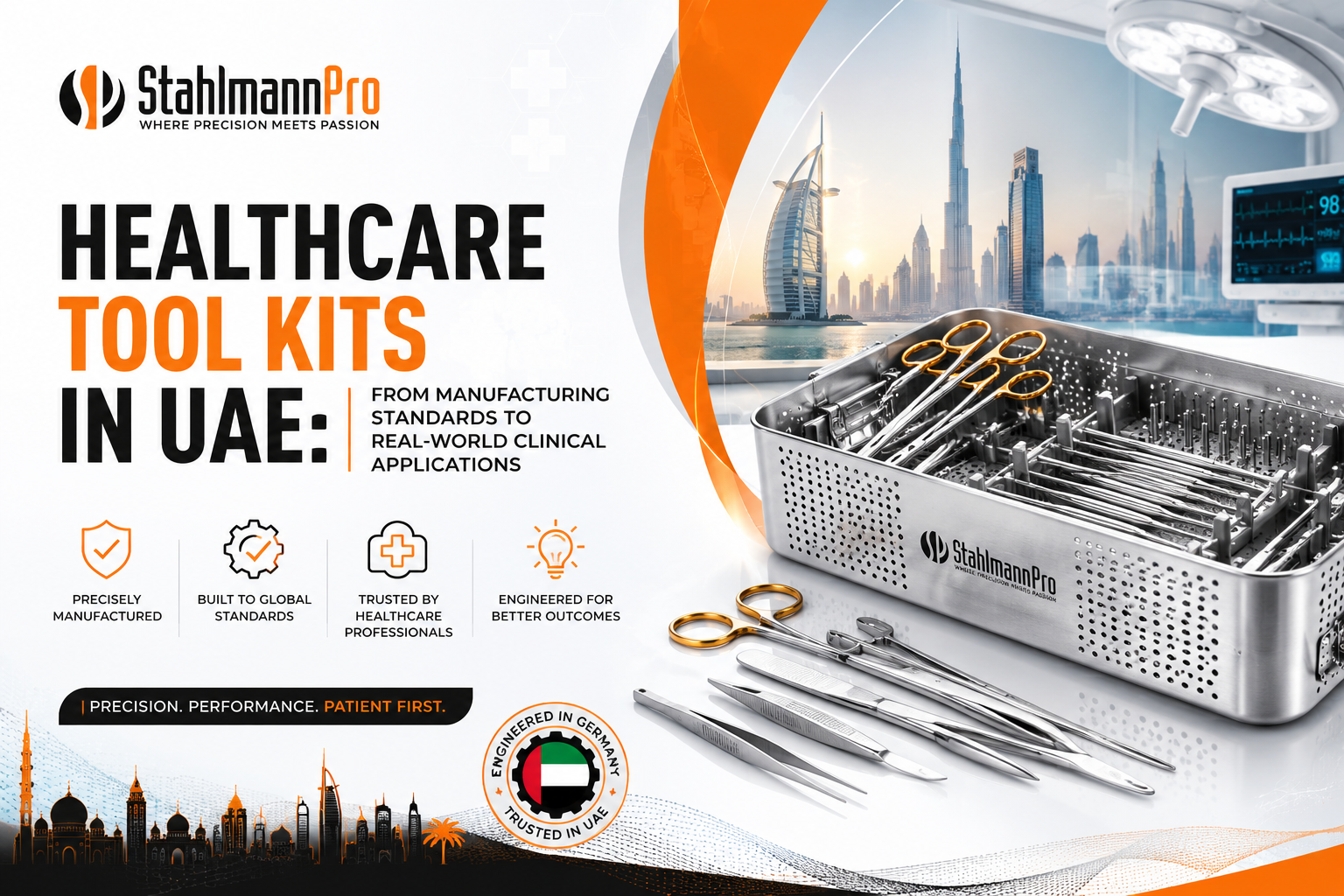
Why Healthcare Tool Kits Matter in the UAE
The healthcare sector in the United Arab Emirates (UAE) has rapidly evolved into one of the most advanced medical ecosystems in the Middle East. With world-class hospitals, cutting-edge surgical centers, and a strong focus on medical tourism, the demand for high-quality healthcare tool kits has increased significantly.
Healthcare tool kits—ranging from basic surgical instruments to highly specialized diagnostic sets—form the backbone of modern clinical practice. These kits are not just collections of instruments; they are precision-engineered systems designed to ensure safety, accuracy, and efficiency in medical procedures.
In the UAE, healthcare tool kits are strictly regulated and must comply with international manufacturing standards, including ISO certifications, CE marking, and regulatory approvals from local health authorities such as the Emirates Drug Establishment (EDE) and Ministry of Health and Prevention (MOHAP).
This blog explores how these tool kits are manufactured, regulated, and ultimately used in real-world clinical environments across the UAE.
Understanding Healthcare Tool Kits: What They Include
Healthcare tool kits are structured sets of medical instruments used in hospitals, clinics, and surgical centers. They are designed to support specific medical procedures.
Common types of healthcare tool kits include:
- Surgical instrument kits (general surgery, orthopedic, cardiovascular)
- Emergency trauma kits
- Diagnostic tool kits
- Dental instrument kits
- Gynecology and obstetrics kits
- Laparoscopic and minimally invasive surgery kits
Each kit is carefully assembled to ensure that healthcare professionals have immediate access to the required tools during procedures, reducing delays and improving patient outcomes.
Manufacturing Standards: The Foundation of Medical Safety
The reliability of healthcare tool kits depends heavily on manufacturing standards. In the UAE market, only internationally certified products are accepted in hospitals and healthcare facilities.
1. ISO 13485 Quality Management System
Manufacturers must comply with ISO 13485, which ensures a quality management system specifically designed for medical devices. This standard focuses on:
- Product consistency
- Risk management
- Sterilization processes
- Traceability of instruments
- Regulatory compliance
This certification is often a baseline requirement for exporting medical tools to the UAE healthcare market.
2. CE Marking and International Compliance
CE marking indicates that a product meets European safety, health, and environmental protection standards. In UAE procurement systems, CE-marked devices are widely accepted as proof of quality and safety compliance.
3. Material Standards (Medical-Grade Steel and Alloys)
Most surgical instruments in healthcare tool kits are manufactured using:
- Surgical-grade stainless steel (304, 316L)
- Titanium alloys for orthopedic tools
- Non-reactive polymers for disposable instruments
These materials ensure corrosion resistance, durability, and patient safety during repeated sterilization cycles.
4. Traceability and UDI Systems
Modern healthcare tool kits are increasingly adopting Unique Device Identification (UDI) systems. This allows hospitals to track each instrument from manufacturing to clinical use, improving safety and recall efficiency.
UAE Regulatory Framework for Healthcare Tool Kits
The UAE has one of the most structured regulatory environments for medical devices in the region. Healthcare tool kits fall under strict regulatory supervision to ensure patient safety.
1. Emirates Drug Establishment (EDE)
The EDE is now the central authority responsible for medical device regulation in the UAE, including registration, approval, and compliance monitoring.
Manufacturers must register their healthcare tool kits before they can be sold or distributed in the UAE market.
2. MOHAP Compliance Requirements
The Ministry of Health and Prevention (MOHAP) still plays a significant role in overseeing compliance standards. Key requirements include:
- Device registration before importation
- Submission of technical documentation
- Proof of international certification
- Local authorized representative (distributor requirement)
3. Classification of Medical Devices
Healthcare tool kits are classified based on risk levels:
- Class I: Low-risk tools (basic surgical instruments)
- Class II: Moderate-risk devices
- Class III: High-risk surgical tools and implants
- Class IV: Critical life-support devices
This classification determines approval timelines and documentation requirements.
From Factory to Hospital: The Supply Chain Journey
The journey of healthcare tool kits from manufacturing to clinical use involves several critical stages.
Step 1: Design and Engineering
Medical engineers design instruments based on:
- Clinical requirements
- Surgeon feedback
- Ergonomic safety standards
Step 2: Manufacturing and Quality Control
Manufacturing involves:
- Precision machining
- Heat treatment processes
- Polishing and finishing
- Sterilization testing
Each batch undergoes strict quality checks before packaging.
Step 3: Sterilization and Packaging
Healthcare tool kits must be:
- Sterile-packed in controlled environments
- Sealed to prevent contamination
- Labeled with batch and traceability codes
Step 4: Regulatory Approval and Import
Before entering the UAE market:
- Products must be registered under EDE
- Compliance documentation is verified
- Import permits are issued
Step 5: Hospital Procurement and Clinical Use
Once approved, hospitals and clinics procure tool kits for:
- Operating rooms
- Emergency departments
- Specialized surgical units
Real-World Clinical Applications in UAE Hospitals
Healthcare tool kits are essential in almost every medical procedure performed in UAE hospitals.
1. Surgical Procedures
In operating rooms, surgeons rely on specialized kits for:
- Orthopedic surgeries (bone fixation, joint replacement)
- Cardiovascular procedures
- General abdominal surgeries
These kits ensure precision and reduce surgical time.
2. Emergency and Trauma Care
Emergency departments use trauma kits for:
- Road accident injuries
- Internal bleeding management
- Rapid surgical interventions
Speed and accuracy in such cases are critical for patient survival.
3. Minimally Invasive Surgery
Laparoscopic kits allow surgeons to perform:
- Gallbladder removal
- Hernia repair
- Gynecological procedures
These kits improve recovery time and reduce hospital stays.
4. Diagnostic Applications
Diagnostic tool kits are used in:
- Blood sampling
- Biopsy procedures
- Imaging support systems
They play a key role in early disease detection.
Technological Advancements in Healthcare Tool Kits
The UAE healthcare system is rapidly adopting new technologies to enhance surgical precision.
Key innovations include:
- AI-assisted surgical instruments
- Smart tracking systems for tool usage
- Antimicrobial coatings
- Robotic-assisted surgical kits
These advancements are improving patient safety and reducing human error in clinical environments.
Challenges in the UAE Healthcare Tool Kit Market
Despite strong growth, several challenges remain:
- Strict regulatory approval timelines
- High dependency on imported instruments
- Cost pressure on hospitals
- Need for continuous staff training on new tools
However, these challenges also create opportunities for innovation and local manufacturing growth.
Future Outlook: The Next Phase of Medical Tool Kits in UAE
The future of healthcare tool kits in the UAE is strongly linked to:
- Digital healthcare transformation
- Smart hospitals
- AI-driven surgical systems
- Local manufacturing initiatives under UAE Vision 2031
The demand for highly specialized, traceable, and intelligent tool kits will continue to grow as hospitals move toward fully integrated smart healthcare systems.
Conclusion
Healthcare tool kits are a critical component of modern medical systems in the UAE. From strict manufacturing standards like ISO 13485 to regulatory oversight by EDE and MOHAP, every stage ensures patient safety and clinical excellence.
As UAE healthcare continues to evolve, the integration of advanced technologies and global compliance standards will further enhance the reliability and efficiency of these essential medical instruments.
The future of healthcare tool kits is not just about tools—it is about precision, trust, and life-saving innovation.
Frequently Asked Questions (FAQs)
1. What are healthcare tool kits used for in hospitals?
Healthcare tool kits are used for surgeries, diagnostics, emergency care, and specialized medical procedures.
2. Are medical tool kits regulated in the UAE?
Yes, they are regulated by EDE and MOHAP, requiring strict registration and compliance with international standards.
3. What is the most important manufacturing standard for medical tools?
ISO 13485 is the most important quality management standard for medical device manufacturing.
4. Why is CE marking important for healthcare tools?
CE marking ensures that the product meets international safety and performance standards.
5. What materials are used in surgical tool kits?
Common materials include surgical-grade stainless steel, titanium, and medical-grade polymers.
6. Are healthcare tool kits reusable?
Some are reusable after sterilization, while others are single-use depending on the procedure type.
