
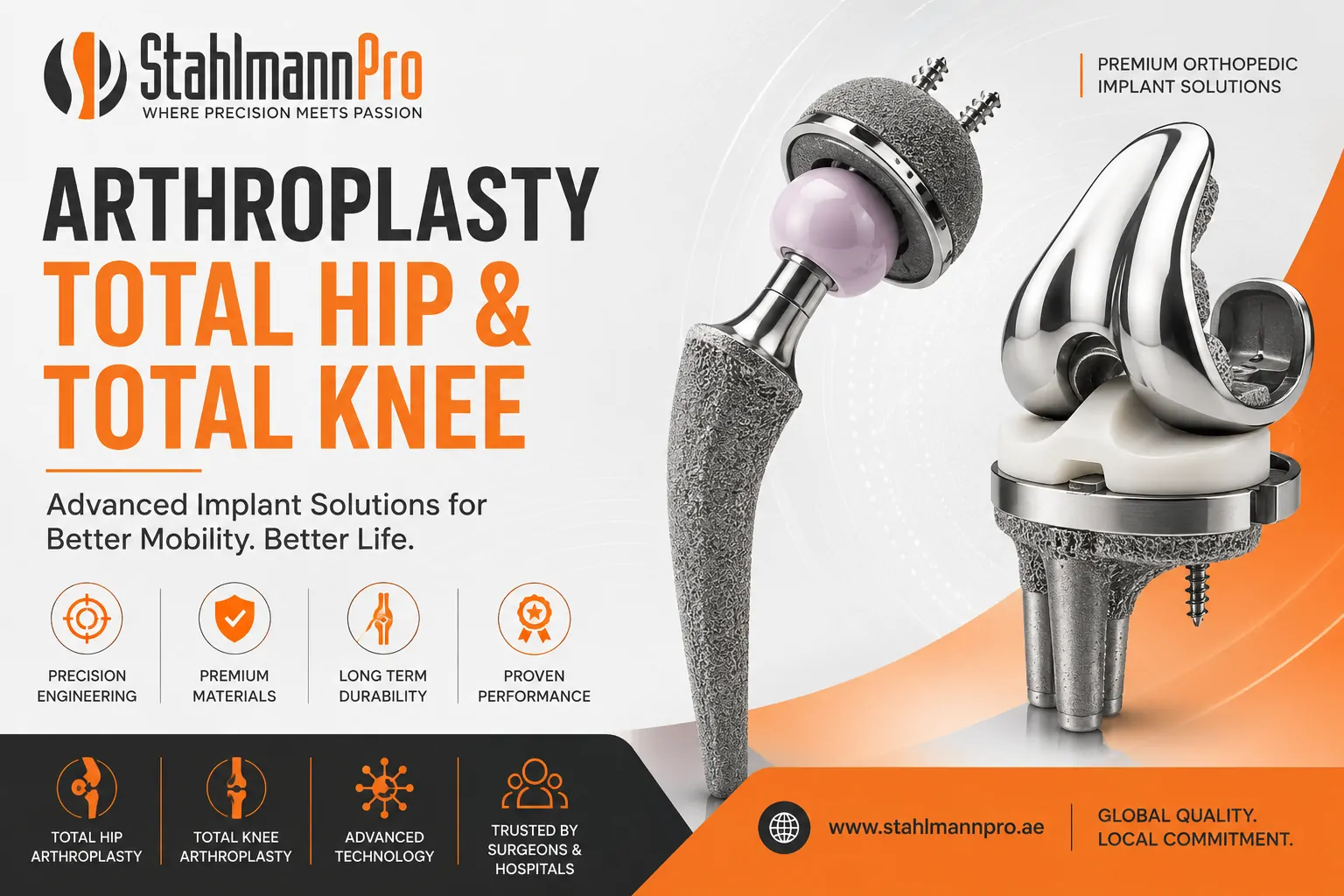
Arthroplasty Total Hip & Total Knee Replacement Solutions
Joint pain can severely affect mobility, independence, and overall quality of life. Modern Arthroplasty Total Hip & Total Knee procedures have transformed orthopedic surgery by helping patients regain movement, reduce chronic pain, and return to daily activities with improved confidence and comfort. As the demand for advanced total joint replacement procedures continues to rise worldwide, hospitals, orthopedic surgeons, and ambulatory surgery centers increasingly rely on precision-engineered implant systems that deliver long-term performance and reliability.
Today,Total Hip Replacement and Total Knee Replacement are among the most successful orthopedic procedures performed globally. Advances in implant design, biomaterials, and surgical techniques have significantly improved patient outcomes while reducing recovery times and implant wear.
Modern hip and knee implant systems are now developed with advanced biomechanical engineering to provide better articulation, enhanced fixation, and improved long-term survivorship.
At Stahlmann Pro, we specialize in advanced orthopedic arthroplasty implants engineered to support modern surgical expectations and long-term patient satisfaction. Our implant systems combine precision manufacturing, premium-grade materials, and international quality standards to support orthopedic professionals, hospitals, and medical distributors worldwide.
Understanding Arthroplasty
Arthroplasty is a surgical procedure designed to restore the function of damaged joints by replacing worn or diseased joint surfaces with artificial implants. These procedures are commonly performed when conservative treatments such as medication, physiotherapy, or injections no longer provide sufficient pain relief or mobility improvement.
The most common types of arthroplasty include:
- Total Hip Arthroplasty (THA)
- Total Knee Arthroplasty (TKA)
These procedures are widely used to treat:
- Osteoarthritis
- Rheumatoid arthritis
- Avascular necrosis (AVN)
- Post-traumatic joint degeneration
- Severe joint injuries
- Failed previous joint surgeries
ModernArthroplasty Total Hip & Total Knee procedures focus not only on pain relief but also on restoring natural movement, improving stability, and supporting long-term mobility. Advanced implant systems now incorporate anatomical designs, precision surface engineering, and enhanced biomaterials to improve osseointegration and reduce wear over time.
For example, younger and more active patients increasingly expect joint implants to support mobility for decades. This has encouraged orthopedic manufacturers to develop more durable implant systems with highly advanced articulation technologies and wear-resistant materials.
Advanced Arthroplasty Total Hip & Total Knee Implant Systems
Modern arthroplasty procedures require implant systems that combine durability, anatomical accuracy, and biomechanical precision. Today’s advanced implant solutions are designed to restore natural movement while improving long-term stability and patient comfort.
Both hip and knee replacement systems rely heavily on:
- Precision engineering
- Biocompatible materials
- Surface technology
- Wear resistance
- Long-term fixation
At Stahlmann Pro, our advanced hip and knee implant systems are developed to meet international orthopedic standards while supporting the evolving needs of surgeons, hospitals, and medical procurement teams.
Total Hip Arthroplasty (THA)
Total Hip Arthroplasty is performed when the hip joint becomes severely damaged and conservative treatment methods no longer provide relief. In this procedure, damaged bone and cartilage are replaced with artificial implant components engineered to restore smooth articulation and joint stability.
A modern hip replacement system typically includes:
- Femoral Stem
- Femoral Head
- Acetabular Cup
- XLPE Liner
- Acetabular Screws
Each component plays an important role in recreating natural hip biomechanics.
The femoral stem provides structural support within the femur, while the femoral head articulates inside the acetabular cup to restore natural hip movement. Advanced XLPE liners help reduce wear debris generation and improve implant longevity, especially for younger and more active patients.
One major advancement in Total Hip Replacement is the use of porous-coated implant surfaces that support biological fixation. Cementless hip implants encourage natural bone growth onto the implant surface, helping improve long-term implant stability.
For example, many orthopedic surgeons now prefer titanium porous-coated stems because of their excellent biocompatibility and ability to reduce stress shielding. These innovations have significantly improved survivorship rates in modern hip arthroplasty procedures.
At Stahlmann Pro, our hip arthroplasty solutions are designed to support:
- Anatomical accuracy
- Long-term fixation
- Reduced implant wear
- Enhanced range of motion
- Surgical flexibility
Total Knee Arthroplasty (TKA)
Total Knee Arthroplasty is designed to restore knee function in patients suffering from severe cartilage loss or advanced joint degeneration. Because the knee experiences complex rotational and weight-bearing movements, modern knee arthroplasty systems require highly precise engineering.
A complete knee replacement system generally includes:
- Femoral Component
- Tibial Component
- Tibial Insert
- Patellar Component
Modern knee implants are engineered to reproduce natural knee kinematics while maintaining stability during movement.
Two commonly used systems include:
- CR (Cruciate Retaining)
- PS (Posterior Stabilized)
CR systems preserve the posterior cruciate ligament, while PS systems use specialized mechanisms to improve stability when the ligament is removed.
One of the biggest challenges in Total Knee Replacement is balancing mobility with implant stability. Poor alignment or inaccurate sizing can negatively affect patient satisfaction and long-term implant performance.
This is why modern implant manufacturers focus heavily on:
- Anatomical contouring
- Range-of-motion optimization
- Surface finishing
- Precision tolerances
For example, highly polished femoral components combined with advanced tibial inserts help reduce friction and improve articulation during movement.
At Stahlmann Pro, our Total Knee Arthroplasty systems are engineered to provide:
- Stable fixation
- Enhanced mobility
- Optimized biomechanics
- Improved wear resistance
- Long-term reliability
Advanced Implant Materials & Engineering
The long-term success of orthopedic arthroplasty implants depends heavily on the quality of materials used during manufacturing. Modern implant systems are expected to withstand years of continuous movement, pressure, and biomechanical stress.
Leading arthroplasty implants commonly use:
- Titanium Alloys
- Cobalt-Chromium Alloys
- Ultra-High Molecular Weight Polyethylene (UHMWPE)
- XLPE Liners
Titanium alloys are widely preferred because they are lightweight, corrosion-resistant, and highly biocompatible. They also support excellent osseointegration, making them ideal for cementless fixation systems.
Cobalt-chromium alloys are commonly used in articulating surfaces because of their exceptional hardness and wear resistance.
One of the most important advancements in modern arthroplasty is the development of Cross-Linked Polyethylene (XLPE) liners. These liners significantly reduce wear particle generation, helping minimize osteolysis and improve implant longevity.
For example, earlier-generation polyethylene liners often produced wear particles that contributed to implant loosening over time. Modern XLPE technology has dramatically improved long-term performance in both hip and knee arthroplasty procedures.
Surface technology also plays a major role in implant stability. Porous-coated implants encourage natural bone in-growth, helping improve fixation without relying entirely on bone cement.
At Stahlmann Pro, our Arthroplasty Total Hip & Total Knee implant systems are engineered using advanced materials and precision manufacturing technologies to support durability, performance, and surgical confidence.
Cemented vs Cementless Arthroplasty
Choosing between cemented and cementless fixation remains an important surgical decision in modern arthroplasty procedures.
Cemented implants use specialized bone cement to secure the implant into position. These systems are commonly
recommended for:
- Elderly patients
- Patients with lower bone density
- Certain revision procedures
Cementless implants rely on biological fixation. Their porous surfaces encourage natural bone growth around the implant.
Younger and more active patients increasingly receive cementless systems because they offer:
- Long-term biological stability
- Reduced risk of cement degradation
- Better load transfer
However, successful cementless fixation depends heavily on:
- Implant surface technology
- Bone quality
- Surgical accuracy
- Implant design
Many modern arthroplasty procedures now use hybrid fixation approaches depending on patient-specific requirements and surgeon preference.
Precision Manufacturing & Quality Assurance
In orthopedic implant manufacturing, even microscopic inaccuracies can impact surgical outcomes. This is why precision engineering and strict quality control are essential for high-performance orthopedic arthroplasty implants.
At Stahlmann Pro, our manufacturing processes are designed around:
- Dimensional accuracy
- Surface consistency
- Material traceability
- Mechanical integrity
Advanced CNC machining technologies help achieve the highly precise tolerances required for modern hip and knee implant systems.
Every implant undergoes rigorous inspection and testing to ensure:
- Mechanical strength
- Corrosion resistance
- Surface quality
- Sterility compliance
- Biocompatibility
International quality standards and regulatory compliance remain critical for hospitals, ambulatory surgery centers, procurement teams, and medical distributors seeking reliable orthopedic implant partners.
This level of quality assurance helps reduce surgical complications while improving long-term implant performance and
surgeon confidence.
Personalized Arthroplasty & Future Technologies
The future of Arthroplasty Total Hip & Total Knee procedures is rapidly moving toward personalized orthopedic solutions.
Modern orthopedic surgeons increasingly use:
- AI-assisted planning
- Digital imaging
- 3D surgical simulations
- Patient-specific instrumentation
These technologies help improve implant positioning and surgical precision.
For example, patient-specific planning allows surgeons to better match implant geometry with individual anatomy, potentially improving alignment and long-term outcomes.
Another rapidly growing trend is robotic-assisted arthroplasty. Robotic systems help surgeons achieve more accurate bone preparation and implant placement while improving surgical consistency.
Future arthroplasty technologies may include:
- Smart implants
- Wear-monitoring sensors
- Digital recovery tracking
- Advanced personalized fixation systems
Companies investing in innovation, precision engineering, and digital orthopedic technologies will continue shaping the future of joint replacement surgery.
Recovery & Functional Outcomes After Arthroplasty
Recovery after total joint replacement depends on multiple factors, including:
- Implant design
- Surgical technique
- Rehabilitation
- Patient health
- Physical activity levels
Modern arthroplasty systems are designed not only to replace damaged joints but also to restore mobility and improve long-term quality of life.
Many patients undergoing Total Hip Arthroplasty experience faster recovery compared to Total Knee Arthroplasty because of differences in joint biomechanics and rehabilitation intensity.
However, advancements in minimally invasive surgical approaches and implant engineering are improving recovery experiences for both procedures.
For example, enhanced recovery protocols now allow some patients to begin walking within hours after surgery.
The combination of advanced implant systems and structured rehabilitation helps improve:
- Range of motion
- Pain reduction
- Functional mobility
- Long-term stability
- Patient satisfaction
Frequently Asked Questions (FAQs)
What is arthroplasty?
Arthroplasty is a surgical procedure used to restore the function of damaged joints by replacing worn or diseased joint surfaces with artificial implants. It is commonly performed for patients suffering from osteoarthritis, rheumatoid arthritis, trauma-related joint damage, or severe joint degeneration. Modern arthroplasty procedures help reduce pain, improve mobility, and enhance long-term quality of life.
What is the difference between total hip and Total Knee arthroplasty?
Total Hip Arthroplasty (THA) involves replacing the damaged hip joint using components such as a femoral stem, femoral head, acetabular cup, and liner. Total Knee Arthroplasty (TKA) replaces the damaged surfaces of the knee joint using femoral, tibial, and patellar components.
Hip replacement procedures generally allow faster recovery and more natural movement, while knee replacement procedures often require more extensive rehabilitation because of the complex biomechanics of the knee joint.
How long do arthroplasty implants last?
Modern arthroplasty implants are designed for long-term durability and can often last 15 to 25 years or more depending on patient activity levels, implant materials, surgical technique, and rehabilitation. Advances in implant engineering, XLPE liners, and surface technologies have significantly improved implant longevity in both Total Hip and Total Knee replacement procedures.
What materials are used in hip and knee implants?
Modern hip and knee implant systems commonly use advanced biomaterials such as titanium alloys, cobalt-chromium alloys, stainless steel, and ultra-high molecular weight polyethylene (UHMWPE). Many modern systems also incorporate XLPE liners to improve wear resistance and reduce implant debris generation.
These materials are selected for their:
- Biocompatibility
- Mechanical strength
- Corrosion resistance
- Long-term durability
- Osseointegration properties
What are the benefits of XLPE liners?
XLPE (Cross-Linked Polyethylene) liners are advanced bearing surfaces used in modern arthroplasty implants to reduce wear and improve implant longevity. Compared to traditional polyethylene liners, XLPE technology produces fewer wear particles, helping minimize osteolysis and implant loosening over time.
Benefits of XLPE liners include:
- Reduced wear rates
- Improved implant lifespan
- Enhanced joint articulation
- Better long-term performance
- Lower revision risk
XLPE liners are now widely used in advanced Total Hip and Total Knee Arthroplasty systems because of their superior durability and biomechanical performance.
Why Choose Stahlmann Pro for Arthroplasty Solutions
At Stahlmann Pro, we believe modern arthroplasty requires more than standard implant manufacturing. It requires precision engineering, advanced material science, and a deep understanding of orthopedic biomechanics.
Our Arthroplasty Total Hip & Total Knee solutions are designed to support:
- Surgical precision
- Long-term durability
- Biomechanical performance
- Reliable fixation
- Enhanced patient outcomes
By combining advanced manufacturing technologies with international quality standards, we continue supporting hospitals, orthopedic surgeons, ambulatory surgery centers, and medical distributors worldwide.
As the global demand for advanced total joint replacement procedures continues to grow, Stahlmann Pro remains committed to innovation, quality, and precision where orthopedic excellence meets long-term patient care.
For more information about our advanced arthroplasty implant systems, contact us at: info@stahlmannpro.ae
