
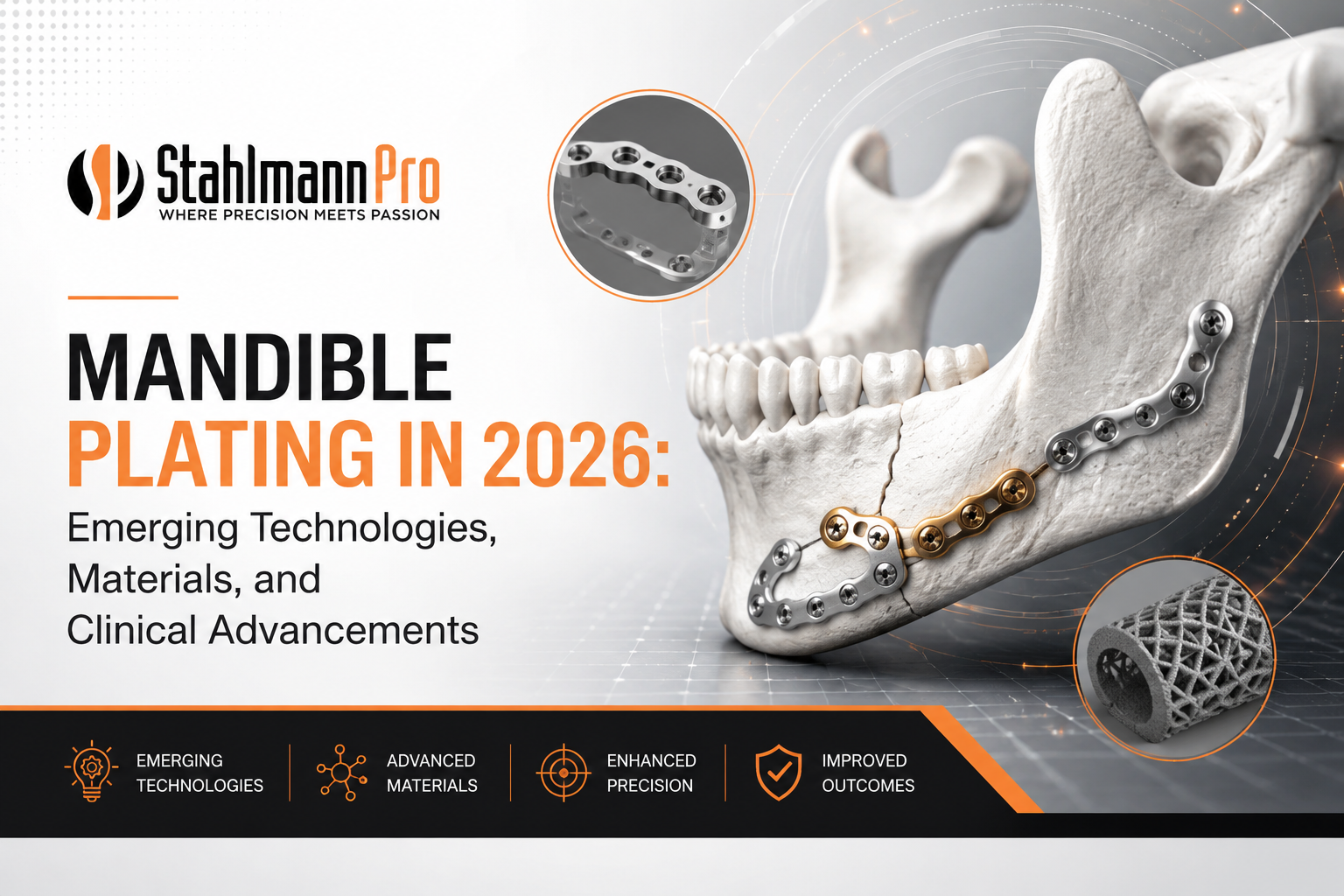
Mandible plating has undergone significant transformation in recent years, driven by advances in biomaterials, digital surgical planning, and patient-specific implant manufacturing. As oral and maxillofacial surgery continues to embrace precision medicine, 2026 marks a pivotal year for mandibular fracture fixation and reconstruction. Surgeons now have access to innovative plating systems that improve surgical accuracy, reduce complications, and enhance patient outcomes.
From custom-designed 3D-printed plates to bioresorbable fixation systems and AI-assisted surgical planning, modern mandibular plating techniques are reshaping the future of craniofacial surgery. This article explores the latest technologies, materials, and clinical advancements influencing mandibular plating in 2026.
Understanding Mandible Plating
Mandible plating refers to the use of specialized plates and screws to stabilize fractures, support bone healing, and reconstruct mandibular defects caused by trauma, pathology, or congenital abnormalities.
Traditionally, titanium plates have been the gold standard due to their exceptional strength, biocompatibility, and long-term reliability. However, the increasing demand for personalized treatment, improved aesthetics, and reduced surgical complications has accelerated the development of next-generation fixation systems.
Today, surgeons are moving beyond conventional fixation methods toward patient-specific solutions that provide superior anatomical adaptation and functional outcomes.
Why Mandible Plating Continues to Evolve
The mandible is one of the most mechanically active bones in the human body. It experiences significant forces during chewing, speaking, and swallowing. As a result, fixation systems must provide:
- High mechanical stability
- Long-term biocompatibility
- Accurate anatomical adaptation
- Minimal surgical complications
- Enhanced patient comfort
- Faster healing and recovery
Modern advancements focus on meeting these requirements while reducing surgical time and improving postoperative outcomes.
The Rise of Patient-Specific Mandible Plates
One of the most important trends in 2026 is the widespread adoption of patient-specific plating systems.
Using CBCT scans, CT imaging, virtual surgical planning (VSP), and CAD/CAM technologies, surgeons can now create custom implants tailored to an individual’s anatomy.
Recent studies have shown that patient-specific plates provide improved accuracy in mandibular reconstruction, better preservation of condylar positioning, and enhanced overall surgical precision compared to traditional pre-bent plates.
Key Benefits of Patient-Specific Plates
Improved Fit
Custom-designed plates conform precisely to the patient’s mandibular anatomy, reducing intraoperative adjustments.
Reduced Surgical Time
Since plates are manufactured before surgery, less time is required for bending and adaptation in the operating room.
Enhanced Accuracy
Digital planning minimizes human error and allows surgeons to achieve more predictable outcomes.
Better Functional Results
Improved alignment contributes to better occlusion, facial symmetry, and jaw function.
These advantages have made patient-specific implants increasingly popular in complex reconstructive procedures and oncologic mandibular surgeries.
3D Printing Revolutionizing Mandibular Fixation
Additive manufacturing, commonly known as 3D printing, has become a cornerstone of modern maxillofacial surgery.
New research published in 2025 demonstrated the development of topology-optimized 3D-printed mandibular bone plates designed specifically for improved fit, mechanical performance, and biocompatibility.
Applications of 3D Printing in Mandible Plating
Custom Reconstruction Plates
Surgeons can create highly individualized fixation systems for complex defects.
Surgical Guides
3D-printed cutting guides improve surgical precision and implant placement.
Anatomical Models
Patient-specific models allow surgeons to practice procedures before entering the operating room.
Rapid Prototyping
Faster design and manufacturing shorten treatment timelines.
As manufacturing technologies continue to mature, the cost and accessibility of 3D-printed solutions are expected to improve significantly.
Advanced Materials Transforming Mandible Plating
Material science remains one of the most exciting areas of innovation in mandibular fixation.
Titanium Remains the Gold Standard
Titanium continues to dominate the market due to:
- Excellent strength-to-weight ratio
- Corrosion resistance
- Outstanding biocompatibility
- Long-term clinical success
Despite newer alternatives entering the market, titanium remains the preferred material for most trauma and reconstructive procedures.
However, researchers are actively exploring materials that address some of titanium’s limitations, including imaging artifacts and the need for secondary hardware removal in select cases.
PEEK (Polyether Ether Ketone) Plates
PEEK has emerged as one of the most promising alternatives to titanium.
A 2026 randomized clinical trial comparing custom-made PEEK plates with titanium plates for mandibular angle fractures demonstrated encouraging clinical and radiographic outcomes.
Advantages of PEEK
- Lightweight structure
- Radiolucency for clearer imaging
- Reduced stress shielding
- Excellent biocompatibility
- Closer elastic modulus to natural bone
These characteristics make PEEK particularly attractive for selected trauma and reconstructive applications.
Bioresorbable Plating Systems
One of the fastest-growing segments in craniofacial fixation involves bioresorbable materials.
These systems gradually degrade after bone healing, potentially eliminating the need for hardware removal.
Modern bioresorbable plates are typically manufactured from advanced polymers such as:
- Poly-L-lactic acid (PLLA)
- Polyglycolic acid (PGA)
- Poly-D,L-lactide (PDLLA)
Recent systematic reviews indicate that resorbable plating systems provide satisfactory fracture stability while offering advantages in pediatric maxillofacial trauma cases.
Benefits of Resorbable Systems
- No secondary removal surgery
- Reduced long-term foreign body presence
- Improved suitability for pediatric patients
- Lower risk of growth restriction
As polymer technology improves, bioresorbable systems are expected to gain wider clinical adoption.
Magnesium-Based Fixation Systems
Magnesium alloys are attracting substantial attention as the next frontier in mandibular fixation.
Researchers are exploring magnesium because it combines:
- Mechanical strength
- Biocompatibility
- Natural biodegradation
Scientific reviews highlight magnesium’s potential as a future alternative to titanium in maxillofacial osteofixation. Although further clinical validation is needed, ongoing research suggests promising applications in craniofacial surgery.
AI and Digital Surgical Planning
Artificial intelligence is rapidly influencing oral and maxillofacial surgery.
In 2026, AI-powered software can assist surgeons with:
- Fracture analysis
- Implant positioning
- Surgical simulation
- Reconstruction planning
- Outcome prediction
Patient-specific digital twins and optimization algorithms are now being investigated to improve mandibular reconstruction planning and enhance bone union outcomes.
Clinical Benefits
- Enhanced treatment planning
- Improved surgical predictability
- Better implant positioning
- Reduced operative risk
- Increased efficiency
As AI technology matures, its role in mandibular reconstruction will likely expand significantly.
Finite Element Analysis Improving Plate Design
Finite Element Analysis (FEA) has become an essential tool for implant development.
Modern researchers use FEA to simulate forces acting on mandibular fixation systems before clinical use.
A 2025 study validated advanced finite element models through mechanical testing of 3D-printed mandibles, helping improve the design and performance of fixation systems.
Why FEA Matters
- Identifies stress concentrations
- Optimizes plate geometry
- Improves mechanical stability
- Reduces implant failure risk
- Accelerates product development
This technology is helping manufacturers create stronger and more efficient plating systems for complex mandibular fractures.
Clinical Outcomes in 2026
Modern mandibular plating systems are delivering measurable improvements in clinical outcomes.
Current Benefits Observed
Faster Surgical Procedures
Digital workflows and patient-specific implants reduce intraoperative adjustments.
Improved Accuracy
Customized fixation systems provide superior anatomical adaptation.
Better Functional Recovery
Patients experience improved occlusion, speech, and mastication.
Reduced Complications
Advanced materials and planning technologies contribute to lower rates of hardware-related issues.
Enhanced Aesthetic Results
Accurate reconstruction helps restore facial symmetry more effectively.
These improvements are particularly valuable in trauma cases, orthognathic surgery, and mandibular reconstruction following tumor resection.
Challenges Facing the Industry
Despite remarkable progress, several challenges remain.
Cost Considerations
Custom implants and digital planning systems may increase treatment costs.
Regulatory Approval
Emerging materials require extensive clinical validation before widespread adoption.
Manufacturing Complexity
Patient-specific implants require sophisticated workflows and specialized expertise.
Training Requirements
Surgeons must learn advanced digital planning and manufacturing technologies.
As adoption increases, however, many of these barriers are expected to decrease.
The Future of Mandible Plating
Looking ahead, the future of mandibular fixation will likely involve:
- Fully customized implant ecosystems
- AI-assisted surgical decision-making
- Smart implants with embedded sensors
- Advanced biodegradable metals
- Faster point-of-care manufacturing
- Enhanced regenerative bone technologies
The convergence of digital dentistry, biomaterials engineering, and artificial intelligence is creating unprecedented opportunities for improving patient outcomes.
Mandible plating in 2026 is no longer limited to simply stabilizing fractures. It has evolved into a highly personalized, technologically sophisticated approach that prioritizes precision, functionality, and long-term patient satisfaction.
Conclusion
Mandible plating is entering a new era characterized by personalization, advanced biomaterials, and digital innovation. While titanium remains the foundation of mandibular fixation, emerging technologies such as patient-specific implants, 3D printing, PEEK plates, bioresorbable systems, and AI-driven surgical planning are reshaping clinical practice.
For oral and maxillofacial surgeons, these innovations provide greater accuracy, improved outcomes, and more predictable treatment pathways. For patients, they offer faster recovery, enhanced function, and better long-term quality of life.
As research continues to advance, mandibular fixation systems will become even more precise, biologically compatible, and tailored to individual patient needs.
Frequently Asked Questions (FAQs)
What is mandible plating?
Mandible plating is a surgical technique that uses plates and screws to stabilize fractures, support bone healing, or reconstruct mandibular defects caused by trauma, disease, or surgery.
Why is titanium commonly used in mandibular plates?
Titanium offers excellent strength, corrosion resistance, biocompatibility, and long-term clinical reliability, making it the preferred material for many fixation procedures.
What are patient-specific mandibular plates?
Patient-specific plates are custom-designed implants created using digital imaging and 3D planning technologies to match a patient’s unique anatomy.
Are bioresorbable plates safe?
Yes. Modern bioresorbable plating systems have demonstrated good clinical outcomes and gradually dissolve after bone healing, reducing the need for hardware removal.
What is PEEK in mandibular fixation?
PEEK (Polyether Ether Ketone) is a high-performance polymer that offers excellent biocompatibility, radiolucency, and mechanical properties suitable for selected mandibular fixation procedures.
How is AI used in mandibular reconstruction?
AI assists surgeons with treatment planning, implant positioning, surgical simulation, and predictive modeling to improve accuracy and clinical outcomes.
What role does 3D printing play in mandibular surgery?
3D printing enables the production of custom plates, surgical guides, anatomical models, and patient-specific implants that improve surgical precision and efficiency.
What is the future of mandible plating?
Future advancements include smart implants, biodegradable metals, AI-assisted surgery, regenerative technologies, and highly personalized fixation systems.
