
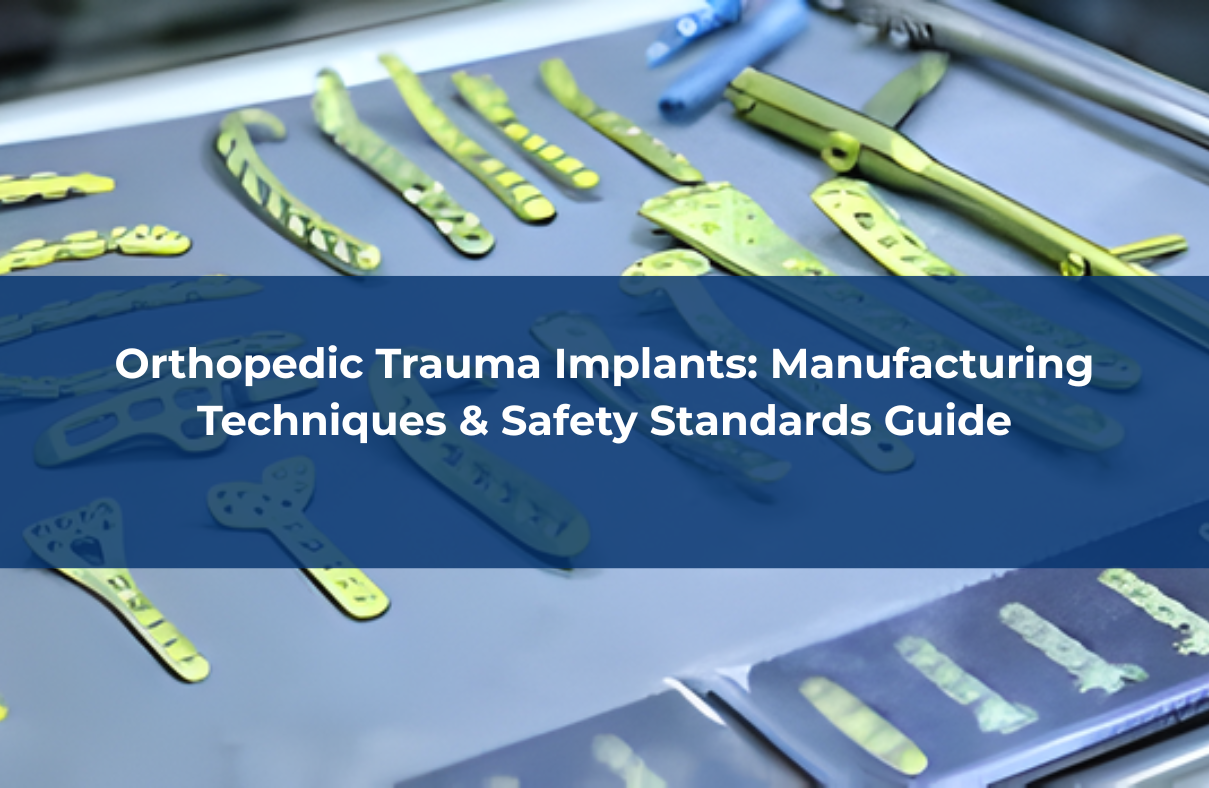
Orthopedic trauma implants play a critical role in modern healthcare. They are used to stabilize fractures, support bone healing, and restore mobility after injuries.
Because these devices are implanted inside the human body, their manufacturing must meet the highest standards of precision, safety, and reliability. Even a minor defect can lead to serious complications.
This guide explains how orthopedic trauma implants are manufactured and the safety standards that ensure their performance and patient safety.
What Are Orthopedic Trauma Implants?
Orthopedic trauma implants are medical devices designed to fix broken bones. Common examples include plates, screws, rods, and nails.
These implants are used in emergency and reconstructive surgeries. Their primary function is to hold bones in the correct position during healing.
They must withstand stress, resist corrosion, and integrate safely with human tissue. This makes their manufacturing process highly specialized.
Key Materials Used in Implant Manufacturing
Material selection is one of the most critical steps in implant production. The wrong material can lead to rejection or failure.
Common materials include titanium alloys, stainless steel, and cobalt-chrome. These are chosen for their strength, durability, and biocompatibility.
Some advanced implants also use polymers like PEEK or ceramic coatings to improve performance and reduce wear.
Each material must undergo strict testing to ensure it is safe for long-term use inside the body.
Modern Manufacturing Techniques
Orthopedic trauma implants are manufactured using advanced engineering techniques. Precision is essential at every stage.
Design and Prototyping
The process begins with digital design using CAD software. Engineers create detailed models that match anatomical and biomechanical requirements.
3D printing is often used for prototyping. This allows faster development and customization of implants.
CNC Machining and Precision Engineering
Most implants are produced using CNC machining. This ensures extremely tight tolerances and consistent quality.
Even microscopic errors can affect implant performance. That’s why high-precision equipment is essential in production.
Additive Manufacturing (3D Printing)
Additive manufacturing is transforming the industry. It enables the creation of complex, patient-specific implants.
This technique also improves bone integration by creating porous structures that mimic natural bone.
Surface Treatment and Finishing
Surface finishing improves implant performance and longevity. Techniques include polishing, coating, and anodizing.
These processes enhance corrosion resistance and promote better bonding with bone tissue.
Sterilization and Packaging
Before reaching the market, implants must be sterilized and packaged in controlled environments.
Each product includes traceability information such as lot number, expiration date, and sterilization details.
This ensures accountability and safety throughout the product lifecycle.
Safety Standards and Regulatory Requirements
Orthopedic implants are among the most regulated medical devices. Strict standards ensure patient safety and product reliability.
ISO Standards
One of the most important frameworks is ISO 13485, which defines quality management systems for medical devices.
Another key standard is ISO 14630, which outlines general requirements for non-active surgical implants, including design, materials, manufacturing, and testing.
These standards ensure that implants meet global safety and performance benchmarks.
FDA Regulations
In the United States, implants must comply with FDA regulations under 21 CFR Part 820.
This includes design validation, process control, documentation, and post-market monitoring.
Devices are approved through pathways such as 510(k) clearance or premarket approval (PMA), depending on their risk level.
Biocompatibility and Mechanical Testing
Implants must undergo rigorous testing before approval. This includes fatigue strength, mechanical durability, and biological response testing.
Biocompatibility tests ensure the material does not cause harmful reactions inside the body.
Mechanical tests confirm the implant can withstand real-life stress conditions.
Quality Control and Risk Management
Quality assurance is a continuous process in implant manufacturing. It begins with raw material inspection and continues through final testing.
Manufacturers use advanced inspection tools to detect even the smallest defects. This reduces the risk of implant failure.
Strict documentation and traceability systems ensure every implant can be tracked throughout its lifecycle.
Failure to meet quality standards can result in serious consequences, including revision surgeries and patient harm.
Why Manufacturing Standards Matter
Orthopedic implants are life-critical devices. Their performance directly impacts patient recovery and long-term health.
High-quality manufacturing reduces complications such as implant loosening, infection, or mechanical failure.
It also improves patient outcomes by ensuring faster recovery and better functionality.
As demand for orthopedic procedures grows, maintaining strict safety standards becomes even more important.
Future Trends in Orthopedic Implant Manufacturing
The industry is rapidly evolving with new technologies. Personalized implants are becoming more common due to 3D printing.
Smart implants with sensors are also being explored. These can monitor healing and provide real-time data to doctors.
Advanced materials are being developed to improve durability and reduce rejection rates.
Innovation will continue to shape the future of orthopedic trauma care.
FAQs
What are orthopedic trauma implants used for?
They are used to stabilize and support broken bones during the healing process, ensuring proper alignment and recovery.
What materials are commonly used in implants?
Titanium, stainless steel, and cobalt-chrome are widely used due to their strength and biocompatibility.
What safety standards apply to orthopedic implants?
Key standards include ISO 13485, ISO 14630, and FDA regulations such as 21 CFR Part 820.
How are implants tested for safety?
They undergo mechanical testing, fatigue analysis, and biocompatibility testing to ensure durability and safety.
Why is quality control important in implant manufacturing?
It ensures reliability, reduces risks of failure, and protects patient health during and after surgery.
